- cross-posted to:
- lemmyshitpost@lemmy.world
- cross-posted to:
- lemmyshitpost@lemmy.world
cross-posted from: https://piefed.social/c/lemmyshitpost@lemmy.world/p/2500128/banana-for-scale
Banana for scale
You must log in or register to comment.
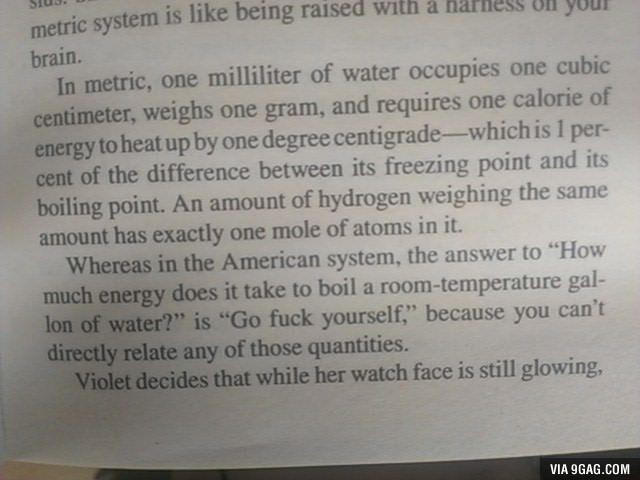
Calories aren’t metric. 1 calorie is 4.184 Joules.
Also, a calorie is only 0.99857% of the energy needed to raise a gram of water (without gas dissolved in it) from freezing to boiling at 101325 Pascal of gas pressure, not 1% as the OOP states. 101325 Pascal perhaps being better known by the non-metric unit “1 atmosphere”.
if you’re going to nitpick then make sure you’re not technically incorrect.
You’re talking about the SI system, which is a metric system but not the metric system.Quoth wikipedia (yes wikipedia isn’t a source, but i’m not the one who started nitpicking so i don’t have to be nitpick proof :^)
“… metric system refers to ones that standardise a set of base units and a nomenclature describing relatively large and small quantities using decimal-based multiplicative unit prefixes (such as kilo and milli). The International System of Units (SI) is a good example, and there are other widely accepted systems (less popular than SI) mainly used in specific fields, such as the Gaussian units for electromagnetism.”How did you calculate the required energy from freezing to boiling? Specifically which boiling point and what heat capacity function did you integrate?
I went to the wikipedia page for ‘calorie’ and saw it written there.
This guy SI’s
TIL one gram of hydrogen is one mole of hydrogen. Neat!
It actually isn’t, it’s quite close, but due to nuclear binding energy 1 mole of hydrogen is actually a little more than a gram. Because the mole is defined for C12, it is the only nuclide (atom with a specific number of protons and neutrons) where a mole is it’s atomic number in grams, 12 in the case for C12
Yep. Those numbers on the periodic table tell you how many grams one mole is. I think one of them is the average isotopic valie and the other is the ideal value.
Who is Violet, and why does her watch glow matter? More to the point what book is this?
It seems this is a quote from Wild Thing, by Josh Bazell. I have not personally read this book, and so cannot confirm beyond what a quick lookup told me. Cheers.
Thanks!
Neat. Now use metric time. Tell me, how many kiloseconds are in a day and megaseconds in a year?
In the same way people seem to be able to learn there are 60 seconds in a minute, I know there are 12 inches in a foot.
Metric is wonderful scientifically and annoying practically. I’m with Orwell, I like a pint of beer, not 500 mL or 1 L.
… annoying practically
Said no one actually familiar with the metric system, ever.
How would being educated exclusively in metric in a metric country not make me familiar?
I immigrated to a common unit nation as an adult.
Given I am a person and better and familiar with metric (and know plenty of immigrants who agree), your point is not valid.
How many years have you lived in a common unit nation to experience the difference?
how many kiloseconds are in a day and megaseconds in a year
I hope you are joking, because this is the kind of calculations that metric makes appealing, because they are no different than how many seconds are in 3 or 24 hours. If you are not joking, then you have to rethink your education, no offense intended. Here: 246060/1000 = 86.4 ks in a day, and approximately 365.25 times this number over 1000 is 31.5576 Ms in a year. Some, you know, elementary school shit.
Seriously, one could say that, specifically regarding time, base 60 is more practical for everyday use. It is easily divisible with common fractions of time, like 1/2, 1/3, 1/4, 1/5 of 60 are all meaningful fractions of an hour (30, 20, 15).
On top of that, time is one domain of everyday life that humanity is constrained by random, global constants, like earth’s rotation and the (approximately) 24-hour day cycle. Earth as part of the planetary system is not a human construct and thus it can’t be made to taste, using any system. (But roads, ships, boxes, and bottles can.)
Having shortcut names for common subdivisions of anything is not an argument in itself. In fact this is a combination of fallacies. 1. Proponents of the metric system prefer its far-reaching consistency (base-10 for measuring most things, and at any scale however large or small; the original reason your argument is fallacious). Imperial has arbitrary bases for different things.
- Citing “megaseconds” and the like is just whataboutism. There are microseconds and milliseconds in common use, as a counter, as well as hectoseconds and other divisions in use, depending on application. Your computer does not count years, days, hours or minutes, it calculates them to make its internal time representation more user friendly.
In fact, the imperial system’s cultural ramifications are way more important than the choice of system. If the US wasn’t deeply a backwards international pariah run by homeschooled cultist criminals with zero critical thinking skills, as demonstrated above, it would have adopted metric at least partially, like all industrialized nations. It correlates fully with its 1st and 2nd Amendment conundrums (its inability to interpret the constitution beyond face value, and thus be unable to ban hate speech and selling battlefield weaponry in grocery stores), and it comes as no surprise this fascist takeover is happening right now in the land of weekly mass shootings at schools.
It is like meeting someone for the first time and him quoting Jordan Peterson, US’s imperial system fixation is a red flag for its national character in whole.
Metric is wonderful scientifically and annoying practically.
It is annoying to you because you are not used to it. It is perfectly fine and very useful for the rest of us.
I spent all but four of the first 25 years of my life in a metric country. It was the only system I was taught. I defended it as you did.
It is perfectly fine. However, most here have never used both for extended periods in their lives to judge. I have.
i’m genuinely struggling a lot to figure out what your argument is here
“The story of the metric system starts, somewhat unexpectedly, in 17th Century England, with the proposal by the natural philosopher John Wilkins for a consistently decimal system of units. The Europe of his time was divided by the use of innumerable different systems of measure, with each country using its own traditional units (and in many cases, a lack of even national standardisation meant that different regions within countries would use their own measures). To remedy this, Wilkins conceived of a single, rational standard, based on the best science of his time, which all nations could equally share. His idea for a “universal Measure” was not adopted in his era, although that very phrase would ultimately (via Greek translation) give us the name of the metre.”

Certainly happy to expand.
The practical use of units derives from the features of our environments and what is important to us in our lives The length of a day is one of them. The characteristics of water is not, and that is where metric is derived.
When one asks the temperature in the morning, one is not asking how much energy went into a volume of water. One is asking how to dress, so appreciable changes in a sense of temperature are appropriate.
When on weighs themselves on a scale, the ability to calculate the volume of water equivalent is not the goal.
I have now evenly split my life in a metric and common country. I grew up with metric, and find common much more practical because it evolved over centuries to be so.
0, wear a sweater. 10, wear a couple layers. 20, wear a shirt. 30, don’t. :)
It’s really what you’re used to.
annoying practically.
Strong disagree here. Maybe if you live in the US where the other units aren’t frequently used yet, it’s annoying. I grew up in the US but now live in Japan where most things are metric. The only big exceptions I can think of that require calculation are a couple of traditional units for property size, room size, and alcohol size (and some of those are slowly becoming less common).
I would love an explanation on how you find metric “annoying practically”
It is not annoying practically. As you learn imperial you learn metric all the same
Without even looking it up, 86.4ksec in a day, and 30 megaseconds in a year (525600 minutes). Easy.
I like a 500ml beer. Good size tbh.
What do your clocks and watches display?
Convenient multiples of seconds!
Just like 12 inches to the foot.
I’d be happier with that if it were then 12 feet to the yard, 12 yards to the rod, 12 rods to the mile, 12 miles to the whatever. Duodecimal is great, but imperial doesn’t use it. :)
The only thing that really grinds my gears with metric enthusiasts is their inability to use the system they say they love. I can’t tell you how many times I see these chucklefucks say something is “400 millimeters” when there is a fucking measurement for that. Just say “4 decimeters”, god damn double plus bad ignorant asses.
Edit: Nice to see the metric bigots are as tolerant of ridicule as the imperial bigots.
There is no rule that says you need to use the largest unit available, on the opposite the unit used often indicates the precision of the measurement taken. If you say something is 400mm, it’s normal to assume that means 400±1mm. 4dm would be ±1dm.
That would be “4.00 decimeters”. People tend to skip decimeters entirely tbh, large things are measured in meters, small things in centimers, tiny things in millimeters. It is true that my desk is 8 decimeter deep and 24 decimeter wide, but it was listed as 2.4x0.8m in the store.
All deci- are rare actually. I sometimes encounter deciliters in recipes, but they’re just as likely to go for 10 centiliters or 0.1 liters.
yeah, “deci-” is a supermarket exclusive with dg, and even then it’s only used for meat cuts, like ham…
anyone who has worked with blueprints has it hammered into them that you ALWAYS use millimeters to prevent confusion, go complain to the engineers who make sure the buildings you’re in don’t crumble apart.
And yet for pipes and monitors it’s still inches, for deodorants it’s still fl. oz. and PSI for pressure (despite pascal and bar existing).
Nope, it isn’t. The pipes of my AC are sold as 15cm, my monitor box said 68.5cm, my deodorant got 250ml in it and my E-Scooter tires show 2.5 bar on the pump’s display.
For monitors US companies unfortunately managed to screw up the default sizes for everyone so now laptops got “15.6 inches”, but both laptop and monitor packaging also usually says sth. like 40cm on it so that’s fine I guess.
I live in Japan. Pressure is in Bars (or, for older things, other odd units that are not PSI). Bicycle tires, screens, etc. are called HoweverManyInch-type but also have measurements listed in mm/cm. Nothing here has only floz. I guess imported products may, but I think they technically must be labeled in sensible units for sale.
In Denmark? My pipes in Germany are in mm, my deodorant in ml and my bike’s tire pressure is 4.5 bar. The only things that are in inches are computer-related: Disk sizes, rack sizes and monitors. TV screens diagonals are usually advertised in cm and inches, but if you want to know which tv fits into your shelf, you don’t care for the diagonal, but for width and height, which is metric.
my deodorant in ml
This is true in the US too. In fact:
Fahrenheit is good for exactly one thing: temperature for humans. It’s about the smallest difference in temperature that a human can feel. Anything 0F or below is too fucking cold for humans. Anything 100F or above is too fucking hot for humans. So instead of basing the temperature on what water does out of 100, Fahrenheit bases on how a human feels. Stupid for science, great for humans.
It’s not any better than Celsius though - you are only saying that because you are familiar with Fahrenheit.
Celsius
- 0 - freezing
- 10 - cold
- 20 - room temp
- 30 - hot
- 40 - miserably hot
- 100 - boiling
deleted by creator
The higher resolution of Fahrenheit is wasted on the absolutely subjective experience of ambient temperatures, especially when taking humidity into the equation. At least there is a feelable difference between 20 and 22 °C.
“higher resolution” does bro know what decimals are ?
No, Americans are so dead scared of decimals that they don’t even know what they are.
No, Imperal uses fractions of whatever the fuck they are measuring lol
Given the same number of decimals, Fahrenheit is higher resolution. It can communicate ambient temperatures slightly more efficiently than Celsius, because it is designed to do that and Celsius is not. I can definitely tell the difference between, say, a climate control setting of 70F and 71F. If I wanted that level of control with Celsius, I’d have to communicate/have displayed 3 digits and a decimal point. That is less efficient. Is that a big deal? No. Does it mean Celsius is bad? Also no. I think we here in the US should switch to metric for a number of reasons, but this would be a slight downside to switching. Sorry if that hurts your feelings of superiority but it’s the truth.
Nah.
I think the larger granularity is better when talking about specifically the feeling of air temperature, if for no other reason than it keeps it to whole numbers for the sake of conversation. 76f is a pretty common temperature where I live for a lot of the year. Saying 24c is technically inaccurate, that’s noticeably colder at 75f. Saying 24.4c in a regular conversation is psychotic.
You say 24½°C, if you really need to be that accurate, but I’ve never seen anyone care about that precision in normal conversation, so we just say whole centigrade numbers…
“… and a half” is so much worse than “… point five.”
Hmm, didn’t think of that, but is there no simpler way to say that than “and a half”?
Here in German, “…und ein halb” is also technically correct, but everyone just says “…ein halb” and in my regional dialect that further deteriorates to “…a-halb”.
I guess, “point five” is sufficiently short that you might just go for that, though. In German, it’s one syllable more with “Komma Fünf”… 🫠
In Estonian we don’t have articles AND we usually skip the and in informal spoken language. We just say “27 half” (27 pool) for 27.5
“and half” makes sense. I don’t recall hearing people say that here (East coast US, somewhat southern), but I could see them swallow the “a” and say something like “and’a half.” Still, I almost always see fractions written with decimals, so people just say “point x.”
That half degree flies out the window when humidity changes.
Saying 24.4c in a regular conversation is psychotic.
Doing so is accurate, which many neurodivergent people lean toward, and generally don’t appreciate being called “psychotic”, FYI. Maybe tune that hyperbole —and no, “retarded” isn’t an acceptable alternative, either.
Why stop at one decimal place then? If you want to be accurate you can probably add a few more on there. Rarely do we need even the single decimal point of accuracy though, and it adds two additional characters.
You’ve completely missed my point, but that’s alright. Maybe, read it again later, no rush. 🖖🏼
but saying 25 is not
We know that anything resembling knowledge in the mouth of an USian can result in bullying by the nearest jock. It’s reason enough to be afraid.
I will never understand this argument, how could any temperature scale be more intuitive than “0 is where water freezes, 100 is where it boils”??
Those two things are utterly universal unless you happen to live high up on a mountain (in which case you’ll be off by a couple degrees, oh the horror) and quite possibly the most relevant temperatures for us.
The only other objective and universal temperatures i can think of would be when skin burns and when you get frostbite or something, the latter of which is still questionably objective and both of which are… impractical to use for calibration…
No, that’s ridiculous and arbitrary. 100 degrees Fahrenheit is already way past too fucking hot and zero is far below too fucking cold. Zero to thirty degrees Celsius is a solid cold-to-hot range. 100°C to boil water, a very common human activity, makes far more sense than 212°F, too.
100F is when I boil and 0F is when I freeze. Fahrenheit is better for outside temperature (not baking!) Metric for everything else.
ok but -5F is when i start to freeze and 86 is when i boil so what does that say about you
This assumes for whatever reasons that non-scientists could not have any reason to ever calculate anything with temperature.
If you use °C for a week or two, you’ll get used to what numbers are hot and which ones are cold. But if you ever calculate anything in imperial units for a week or two, you’ll still want to bite your table.
“Knowing things is for nerds!”
–average USian
Is “USian” supposed to be a pejorative? I’ve only seen it used on lemmy, usually in lemmy.ml communities.
No, just a way to avoid using American for a denizen of the US. In my native tongue it means “of the Americas”, and I dislike them too much to let them have the word.
i don’t think it’s a pejorative by itself; it’s just a way to uncouple “American” from “United States of America”, since “American” technically applies to all countries in central, north and south america.
it’s more granular and easier to type i guess, though i don’t use it…
so 50 ought to be the perfect temperature.
also, decimals exist.
Humans like to be about 75% warm.
For sure! I love it when my hands & feet are hypothermic and my core is overheating. 🫠
/s
p-value of 1
Anything 0F or below is too fucking cold for humans. Anything 100F or above is too fucking hot for humans.
… Tell me you’re a privileged US resident w/o using those words. 😶
There is exactly one thing Fahrenheit is good for: thermostats. I hate that my shitty ass thermostat only has increments of 1 whole Centigrade. It’s not a huge problem or anything though, and not worth all the other crap that comes with it
Agree. I will argue for this til the day I die
“my system is the best and i will never change my mind”
– person who has only ever been exposed to the one system
I live in Europe, and have lived in Bhutan.
wrong account
I agree, but I’m committed to the bit.
Gotta commit, or you screw the bit