You can thank reagan for that. Before him, the megawealthy were taxed a LOT (i don’t have exact figures, but it was something like 60%). Then reagan came in with his bullshit “trickle down economy” and that was that.
edit: just saw this is about social security funds, not taxes.
i mean social security is taxes tho
oh, I’m not american and not entirely sure. Thanks for the correction.
Anybody voting for “lower taxes” was scammed into creating a class of ultra rich who don’t help society and that laws don’t apply to.
Reminder that during what many consider America’s middle class golden age for a couple decades after WW2 we were TAXING THE EVERLOVING FUCK OUT OF RICH PEOPLE.
Then, surprise surprise, the rich people started buying off politicians to change all that.
EAT. THE. RICH.
They are blood sucking leeches.
we were TAXING THE EVERLOVING FUCK OUT OF RICH PEOPLE.
Tax avoidance during this period was also at historic highs. One of the perks of the payroll tax was that it collected at the point of the employer rather than being paid directly by the employee. This put the liability for missed payments on the business (which is risk averse) rather than the individual (which often is not) and shrank the labor required for administration from “everyone with an income” to “everyone who pays a salary”.
Curiously, we choose not to do this for stock transactions and other big ticket revenue generating sales. Rather than demanding Wall Street assume liability for the vast number of brokerage sales the big clearing houses oversee, we politely ask that each individual stockholder report gains and losses at the end of the year. Private businesses are even worse. Rather than assessing their revenues through the major transaction arteries - banks and commodities/wholesale exchanges - we wait for businesses to self-report.
All this creates enormous blind spots in how taxation is accessed and collected in a way that practically invites business owners (especially small and low-volume business owners) to lie, cheat, and steal.
EAT. THE. RICH.
It’s a great bumper sticker slogan. But I don’t see any blood on your gums.
I’ve had the desire to write a satirical swiftian letter to the editor to a national paper talking about how to tax Americans “fairly” where every single American pays the same amount in taxes regardless of age and income. Billionaires and babies owing the same amount, some ridiculous amount like $50k per person. Then I realized some people might take it as an actual suggestion and try to put it into practice.
It was a tactical decision to turn people off of socialism/communism.
I think you’ll find it’s no longer needed.
If anything it did the opposite!
A lot of the yanks still hate communism.
Was this after the green new deal?

The original name was “Horse and Sparrow” as in if we give the horse enough to eat, there will be enough undigested food in his shit for the sparrow
Correct me if I’m wrong here.
But isn’t it cumulative?
They pay a certain tax rate on a certain amount of money. So they’re paying 12.2% within the bracket that covers that amount of earnings, then an additional 2.2% only on the income that falls into the next bracket.
So they’re paying the same rate as everyone else on the income within each bracket, right?
I’m sure these medical billionaires made their money in the worst way possible, but to accumulate that kind of wealth they’re generally not earning it as ordinary income.
“Buy, borrow, die” largely avoids income taxes because loans aren’t taxable income.
The issue is far more devious than simply taxing a higher income bracket at a higher percentage.
There has never been a more important issue in our time than the wealth gap and economic inequality.
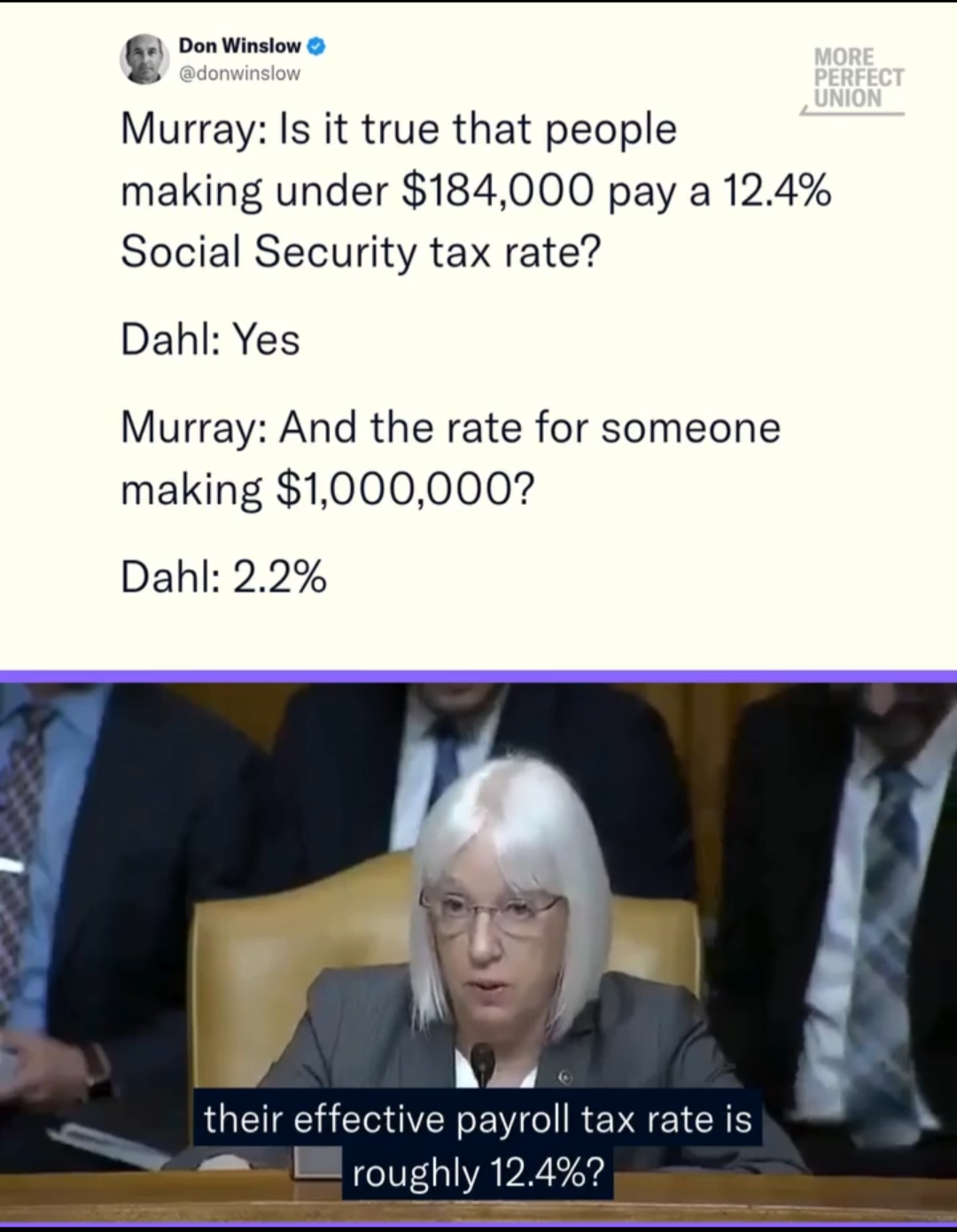
This is mostly right but I think missing the point. It’s not 12.2% on the first bracket and 2.2% on the second. It’s 12.4% on the first $184,000 and ZERO On the rest. The 2.2% is not the marginal rate they are currently paying, it is the effective rate if you add up all the taxes paid divided by all the income. It’s so low because people with salaries beyond 184k stop having to pay any of this tax on their next marginal dollar.
And the reason this is a big deal is because this tax revenue is what is used to fund social security payments for older folks. The social security reserve fund that is running out (which will result in a significant reduction in payment to these old folks) could possibly be all or mostly funded if we made people making more than $184,000 pay the same rate as everyone else.
Damn. How are we not French Revolution-ing these fucks?
love island, throwback nikes, the return of the mcrib, the soap opera of the trump presidencies; they’re keeping us entertained and mollified
Similar amount maybe, not same rate. If the first 100k is taxes at 30% and the rest is at 2%, someone making 100k pays 30k. But someone making 1 million also pays around 30k + 18k maybe. But for the 100k person the total paid was 30%, and for the 1 million person the total paid was maybe 5% of their total. Warsaw away lower.
It’ll trickle down.
You know, because the richest people in the United States are for sure known for giving away money and not hoarding it because they feel they have enough…
It only trickles down to their mercenary politicians and the hatefluencers they buy to keep people ignorant and divided.
This is called a regressive tax. The Republican party should embrace the word regression. Their followers are too stupid to understand its meaning anyway.
In America there’s a contest to see how out-of-date one’s economics can be. If you quote Adam Smith, they’ll call you a pinko.
Social Security is supposed to be like a forced retirement account - what you pay in is what you get out of it later. It was essentially an emergency measure put into place when a lot of Americans were struggling. Since it doesn’t make sense to have a payout above a certain amount, as it would be above the average cost of living, there’s a cap of how much is collected per person per year.
Probably made sense at the time with reasonable minimum wage and super progressive income tax
But that’s never been the way it works. Your payment finances the government budget, one of whose functions is to pay out social security money to current retirees. If you set up the income tax in such a regressive way, there will not be enough money to pay social security, which is of course what Republicans want so that they can have another excuse to cut the program entirely.
Ostensibly you would only draw from SS what you’ve paid into it; of course, that’s only how it’s supposed to work, and not how it actually works. In reality, current SS payments go to pay benefits for current retirees, making it more of a Ponzi scheme that will leave today’s workers hung out to dry with nothing to show for all the money they’ve poured into it when it gets inevitably murdered.
But you still can only draw payments if you’ve been paying into it for at least ten years, which essentially makes it like giving the government a decade-long zero-interest loan.
The Republican party should embrace the word regression.
Never happen. It’s up to all of us to simply start refering to them as regressives so it becomes their name.
I’ve started to say “conservative/regressive” every time I mention them. I’m going to keep doing it and hope others join in until there’s enough of us globally to drop the conservative part since it truly doesn’t apply to them.
The reason this works out that way is because there is a wage base for the social security tax. If you don’t make more than that base then you pay that tax all year long. If you’re making 1m then you pay that tax for like the first two months and then nothing afterwards. The solution to this is just removing the wage base. If you make 1m you should pay the same percentage as everybody else on all your earnings. Magically the social security system will be overfunded.
The other thing to get rid of is long term capital gains taxes and just tax capital gains as regular income.
The point of long term capital gains tax is so people don’t just yank money out all the time. It provides incentive to keep your money in the market.
That said, making the ltcg tax just 2% less than your income tax seems better than a flat 13% or whatever it is.
It provides incentive to keep your money in the market.
No it doesn’t. The vast majority of my stock has LTCG treatment. When I sell, I sell that stock because of the preferential tax treatment and let my non-qualified stock bake longer. You either have the wealth to be in the market and can play the game or you don’t and you’re not in the market. I’ve lived both lives.
Explain please? It’s about the tax rate between those two? I thought the problem with CGT is that people dodge it by taking loans secured by their capital/stock. This does not seem to fix this problem…
LTCG means that I can 15% or 20% (depending on income) on selling stock even if I’m otherwise in a high tax bracket. Why should I get to have a massive tax break just because I already have a lot of income? There’s nothing special about my income from stock vs. my income from employment other than I work a hell of a lot harder for my income from employment than I do my income from stock.
0% if your taxable income is under $96,700 as a married, filing jointly household.
“Normal” people do not avoid paying these taxes by taking loans with their accounts as collateral. That applies only to multi-billionaires.
Most people pay a lower tax rate on long-term capital gains as compared to income. Raising this rate could discourage investing.
Most people don’t have enough capital gains to tax. If they do have capital gains it’s either in there house and unrealized or in a retirement account and deferred. Raising the capital gains tax almost exclusively targets the wealthy, not necessarily billionaires but still top quintile.
Raising this rate could discourage investing.
What else are people going to do with there money then? Keep it in cash and lose even more of it to inflation then you would with the tax?
Also, while paying my property tax bill, I noticed that the government has no problem taxing me for an assessed value of my property without me actually realizing my gains.
Of course, that is a property tax and not a capital gains tax, but it just shows that they definitely don’t have to wait until you sell to tax on capital gains. Just have an official assessment of value for investments.
So what you’re saying is, social security should be, like…social?
It’d also be nice if it offered actual security.
Whoah, settle down there, buddy. Phase one is already sounding pretty far out there and I don’t trust things I don’t comprehend yet. Let me check my source…
…Okay. Fox News says I should be worried and so that’s what I’ll do. Nice try, ya commie bastard! And this is why I pay $8.99 a month to Rupert. Just saved me money.
Removing the income cap is the obvious first step to balancing the social security budget, but it’s not enough to make the system solvent long term.
There are a number of ways to fix the remaining shortfall, but removing the cap is really the only easy measure and we can’t even do that. All others involve some amount of pain. This interactive calculator is worth spending a bit messing with: https://www.crfb.org/socialsecurityreformer/
With Social Security, the amount you get out is directly related to the amount you pay in. So if the cap is increased, yes, social security will get more income, but they’ll also need to start paying out a whole ton more.
It’s more of a forced savings/investment account than a wealth redistribution scheme. There is some redistribution happening, but not as much as most people think.
Social security benefits shouldn’t be proportional to income, it should be a set amount that everyone is eligible and it should be collected proportional to income including capital gains and everything else.
That’s a UBI, not Social Security. It’s a great idea! But it’s not Social Security.
If that were UBI then I would get paid before I was 67.
Social security paying retirement and disability payments is different from UBI. I am simply saying paying in should be proportional to income but the benefits should not.
A CEO and minimum wage worker should get the same social security benefits and they would be higher than they currently are if we taxed the Epstein class properly.
except they mention paying a fraction of whats owed to some future pensioners. Why is it ok for them to pay in more than they get back but its somehow bad for someone of large means to pay in more they get back? Seems like a no brainer on how this should be handled to be equitable to society.
It’s a progressive payout though. SSA pays out 90 percent of average monthly income over 35 years (approximate based on their formula. AIME) below the first “bend” at about 1200 dollars per month, 32 percent between the first and second bend, and 15% above the second bend. So SSA would get 10.6 percent of every new dollar that used to be above the cap, while that dollar would increase the person’s benefit by their marginal rate (likely 32 or 15 for a high earner) divided by 420 months (you could assume the person will have a 35 year retirement to cancel out the two sides of the equation). Turning 10.6 percent into 15-32% (and most of the uncapped money would be likely to fall in the 15% if I had to guess) shouldn’t be a hard thing to do for SSA with extra funds to spare when you consider that the average retiree won’t live for a 35 year retirement and that there are 35 years of gains to capture between money in time vs money out time
We’re talking about a cap and not a base, but yeah… remove the cap and everything gets better.
That’s effectively what it is but it’s called the social security wage base.
TIL - interesting language… even the article goes on to call it a cap multiple times even though the official title is what you listed. Thanks for sharing!
Welcome to American politics: where the rules are made up and the words don’t matter
But… If there cap is 184k, when you retire and get your SSI check, you won’t get more than the next person if you made 1m vs their 184k.
I think the point is the wealthy people are less likely to be reliant of SSI in retirement. So they don’t want to pay into it any more than they have to. If they paid more, they’d end up getting more, so while temporarily it’d be funded better sooner, SS would just pay more out later and still be broken.
And so what? If I pay taxes and never use WIC, is that wrong in some way?
Social Security also funds SSI disability, most of us won’t use that but we pay for it. That’s how taxes work.
The cap should be removed, it’s a tax not a pension plan. We can cap the benefits (higher than it is now) without capping the deduction. Anyone making $1M/year is still going to net hundreds of thousands more than someone making $200K. And both of them will be fine.
If you are reforming SS to raise the cap, why wouldn’t you also reform the payment end as well? There is no reason that the wealthy should get enormous SS payments they don’t need, and allow that to cripple SS for those who do need it.
I can hear the parasites now: “It isn’t fair! The poors get all the breaks!”
I was asking a serious question, not defending the wealthy.
Over funded how? Right now they still collect social security. Are you suggesting they should pay more into SS and then collect less to turn it into a tax?
Pay their fair share is what it is called.6
They do. SS is not a tax. It’s a required investment plan. The reason it’s skewed in percentage is because it maxes out and is shown relative to their income. Just raise taxes the proper way.
Yes.
Why not raise taxes instead of ruining a honorable program?
What does honorable mean in this context? Pay in on what you earn, that’s all. That would be honorable. If you make millions, why do you care? Your retirement is safe either way, help others have at least a little security.
YES
Regressive tax
It is. And it’s wrong. But part of how we got here is it was sold as not being a tax, even though it absolutely is.
The claim was it was a mandatory retirement investment program. Because the wealthy have their own retirements figured out they don’t need their payouts to continue to scale with their income, so their payments in shouldn’t scale proportionally either, under this flawed premise, since it is “not a tax.”
But why it is a tax is, one, most of us will never see a payout because the program is going to collapse before most of us retire, and therefore it is NOT a mandatory retirement program. And second, all payments in and out of government are fungible, so it really is a tax and a separate retirement supplemental program, where we use language around them to pretend they are one program.
Ironically, if we took all the money that was paid into Social Security and invested it in a real portfolio (actual investment), our generation would actually get something, and current generations would be getting significantly more retirement. The issue is that because whether you like government or not, it is a money loser. It’s basically designed to be one. That means using the government as an investment vehicle is in pure investment terms really really bad. Plus it also sets up a regressive tax as you pointed out.
most of us will never see a payout because the program is going to collapse
I have been reading this claim my entire life. Not even my entire adult life. Like, I remember hearing this when I was still a wee little kiddo, watching Reagan give speeches from my dad’s knee.
Social Security isn’t going bankrupt any sooner than the Pentagon goes bankrupt or the US Treasury goes bankrupt. It’s not something that can happen, mechanically speaking. Congress is always free to allocate more money to the program. The only way SS “runs out of money” is if Congress deliberately refuses to fund it.
And so much of the US economy lives downstream of senior citizens getting their checks on time that such a decision would be economically suicidal for the country. If it happens, it’s only because the US as a going concern is a failed state. And a real failed state, not just some hyperbole from the latest pundit circle.
Ironically, if we took all the money that was paid into Social Security and invested it in a real portfolio
You’d have a sovereign wealth fund.
But when you’ve got the national reserve currency, there’s no real incentive to do that. Your tax revenue is already driven by global economic growth. Our Federal Reserve Credit Window and our variety of grants, tax credits, and government contracts already incentivize capital accumulation within the scope of US taxable incomes.
You don’t need to collect a dividend from a business by holding its equity if you’re a federal government. You can just tax them. Dollars paid in dividends and dollars paid in taxes are interchangeable.
I’m not fully versed on the differences, but our Canada Pension plan is invested in various things.
Although, lately has come under fire for investment choices they’ve chosen.
US Social Security is fundamentally not an investment plan. Workers who have not yet retired pay a special tax and this is used to pay benefits to those who have retired. Roughly speaking (using handy numbers) workers pay the tax for 44 years (ages 21 to 65) and collect SS benefits for 11 years (ages 65 to 76) and then die, so in principle four active workers support one retired worker. SS benefits are very small, something like a third of what active workers make on average, so more like twelve active workers support each retired worker, so the tax is a very affordable amount.
Much of the confusion over this resulted in the 1980s, when Congress recognized that the changing demographics in the future (like, 50 years later) would mean fewer workers relative to retirees. They chose to prepare for this in advance by raising the SS taxes slightly above what was needed at the time to support retirees and investing the surplus in US Treasury bonds. This Social Security “trust fund” is now being tapped to provide benefits without raising the tax rate – as well as being used by Republicans to fool people into believing that when the supplemental trust fund is empty, Social Security itself will be “bankrupt”. Not true, because even then SS benefits will continue to be paid, either in slightly lower amounts if the tax rate is not increased, or at the same amounts if the tax rate is increased to cover it.
Incidentally, this SS trust fund is a huge part of what allowed President Reagan to rack up enormous debt without destroying (at least immediately) the US economy. Treasury bonds were paying about 2.5% at the time, so the SS trust fund was essentially a source of cheaply-borrowed money to cover the government’s general budget.
Ours is a sliding rate based on your income. It is a line item on your tax form for the pension plan. For say 75k earnings you’d pay about $4000 to the CPP, employer contributes an equal amount. If you are self employed you have to contribute both the employee and employer amount so about 8K.
The fund has investment managers growing it. But it is still a pyramid of new workers propping up the fund so retired people can draw from it. As life expectancy increases they will probably move retirement age.
Most people only pay half of that and their employer pays the other half. Self employed people pay all of that, that’s me. I don’t have any separate retirement accounts or health insurance benefits either, but none of that is factored into my taxes.
While this is certainly technically true most modern economists believe that companies compensate for this by offering lower wages, so it’s kinds 6 of 1, half dozen of the other.
Maybe put this way, if I didn’t work at my company they wouldn’t pay either half of the social security and medicare. So its mostly me who’s bringing that money to the government since I’m the catalyst.
Can somebody eli12 it for me?
Social Securiry benefits are paid out based in how much you earned during your working years. If you earned more money while working, you get higher monthly benefits when you retire. Up to a certian point:
These benefits cap out at a certain limit. Accordingly, the social security taxes also cap out at a certain limit. Beyond that income you do ‘t get any higher Social Security benefits and you don’t pay any higher Social Security taxes.
This is because Social Security is not designed to be a progressive tax like the income tax is.
Our tax system overall should be more progressive. Maybe social security should be part of that. But it was never designed to do this.
Our tax system overall should be more progressive
Tax brackets are the fundamental way that income tax is used regressive: the higher your income, the higher percentage you pay on that (marginal) income
In addition to “income” shenanigans available to the wealthy, the highest tax bracket is at $750,000 (couples filing jointly). While that’s certainly a lot of income, the percentage never goes higher. Someone earning that pays the same percentage on marginal income as a ten millionaire or a hundred millionaire or a billionaire. It stops progressing
We need to bring back the 92% (marginal) tax bracket.
Social Security is capped at $184,500
SS tax is 6.2% for individual and 6.2% for employer.
Employee A makes $184,500. $11,439 paid by individual and $11,439 paid by employer. $22,878 total.
22,878/184500=.124 or 12.4% tax.
Employee B makes $1,000,000. SS is capped at $184,500. $11,439 paid by individual and $11,439 paid by employer. $22,878 total.
22,878/1,000,000=.022 or 2.2% tax.
So someone making a million dollars would only have to give up 1.1% to SS tax and their employer 1.1% SS tax.
They will both pay the exact same amount into SS but the percentage isn’t as high because $815,500 of the million is not getting taxed.
IIRC both employee A and B will also get the same payout from Social Security, assuming both of their salaries were at that level (at the cap or higher) for most of their careers.
Just looking at social security tax will never give you the full picture though, it’s just a small fraction of overall income taxes. And it misses the fact that wealthy people increase their wealth through other means, like long term capital gains. Someone making $100M per year through investments probably won’t work a day job and will therefore pay $0 social security tax.
Fun fact.
Some one retiring today at 67 after paying the full cap for the last 35 years (1992–2026) would be getting ~4k/month SS, after paying ~479K (half from employer if not self employed) in SS only over 35 years.
The same amount invested would likely result in slightly lower payments at 4% return, but higher with actual market return at higher risk. Plus, allow for wealth transfer to dependents.
So, take that how you will.
(Numbers are rough since the cap is a moving target and 35 years is a long time).
But social security isn’t supposed to be a retirement plan. There’snot supposed to be a “return” on individualinvestment. It’s meant to be a social safety net. Therefore it’s fine for rich people to get less out of it.
It’s also why the retirement age when it was instituted was 2 years above the average American lifespan. It was only meant to cover retirees who had lived longer than expected that they didn’t want dying in the street.
But our lifespans got longer, so the number of people collecting social security as a retirement plan skyrocketed.
And the solution for the time being is simple: remove the $184,000 cap.
A unskilled laborer makes about $18 or $36k a year.
They have to pay 12.4% to social security.
36k×.124=4,464
$4,464
Income Tax
$36k-12,400=23,600
12,400×.1=$1,240
23,600×.12=$2,832
$1,240+$2,832=$4072
$4072
$4,464+$4072=$8,536
These unskilled laborers have to pay nearly a quarter of their pay in SS tax and Income Tax.
$8,536/$1,000,000=.0085
That’s less than 1% to them.
Yes the rich do not need safety nets but they should help build them
If you were making a $1m salary. You could give up less than a precent of that and make one unskilled laborer’s life 25% better.
It’s crazy how much $8,536 more would help someone making $36,000
Yet the system is designed so it takes your $8,536 selling you a safety net
As long as the withdraw rate is based on contribution rate it doesn’t really matter what the cap is, because you’d be increasing withdrawal along with contributions. Social security income for someone who was making $185k/yr will be far more than enough to keep them out of poverty, which is the goal of social security. It’s not meant to be people’s only retirement account, it’s a safety net.
Having rich people pay into a system and then die is just beneficial. Even if their withdrawal rates are based on contributions. They will leave money behind or they with be neutral.
Someone making $36k a year pays $4,464 dollars for SS.
12.4% is a good retirement fund.
So government takes what could be your good retirement fund so you can save another 12.4%?
If someone really could save 24.8% they would have a great retirement. Yet the retirement for someone making $36K a year is looking grim.
But the withdrawal rate shouldn’t be based on contribution. A safety net that only provides for people who are already rich didn’t make any sense.
There’s a cap on how much you (and your employer) pay per SSN / year. So, for particularly high wages or salaries, the percentage goes down, for every dollar made above the cap.
Also, things like stock( option)s often made up a significant portion of compensation for high earners and those aren’t subject to SSI tax at all, IIRC.
The richer you are the more you take and the less you pay back into the system that made you rich. But the parasites will argue their smaller percentage paid in taxes is fine cause of their size even though it means they hoard a larger percentage of their wealth.
The taps at the top needs to open less for the trickling down to happen, that’s common sense! /$
Are the benefits you might receive dependent on how much you contribute?
This seems very “American”. As in, superior American-style-freedom because everyone pays for their own social security.
Social security has a max payout, so it also has a cap on the taxes you pay into it.
At a surface level, it makes sense, which is why it continues.
Once you look into it even a little bit further, the max payout needs to stay, but the tax cap needs to be removed.
I’m pretty sure they are. The more you pay into the system, the more you get at retirement age. But, it’s also capped. I’m assuming that’s the rationale behind capping the tax.
12.4%?!
*cries in dutch 49.5%
They are talking just about social security not full income tax, etc.
Yeah but at least you get something other than murdered brown people half the world away for your tax dollars.
They do murder brown people inside the country and nearby it’s borders as well.
Fair enough
Oh no, do you feel unwell? Do you need to take paid personal leave from work to visit a free doctor?
This is normal in civilized countries.
*it’s not free.
i pay (on top of my tax deductions) about monthly 150eur for health insurance, and on top of that a yearly 384 eur “eigen risico” (own risk). still better than the US, but free it is not.
If you are unable to afford to pay those additional costs, are you unable to access Healthcare?
Looks at the services your government provides you and compare it to America. That should help you feel a little better about the taxes you pay. We end up paying more to private corporations for the same or worse than your taxes pay for.
This is social security,
A big reason US taxes seem lower is because there are so many different taxes and we usually don’t aggregate
Google says you’re specifying the Dutch income tax rate, so it’s not comparable and the Dutch social security tax’s is “only” 27.5%
your “only” is doing some heavy lifting there :) but of course i wouldn’t have it any other way.
Don’t worry - I only take home half my pay as netpay, too, after deductions for tax and retirement and healthcare and have a $4k deductible before my health insurance kicks in.
So it’s not paid in taxes, but works out the same.
As other mentioned its social security and Medicare tax. Social security tax ends after a point and Medicare tax continues (1.45% I think), hence the 2.2% effective tax rate.
What’s missing is also the employer taxes, which are mirrored, this the cost of carrying employees in the US is higher than the gross wage… So the effective tax and real wage is all masked. (Eg if my salary is $100,000 I pay like $12k in social taxes and my employer also does the same, meaning the cost to the employer to hire me is $112,000)
All this said, the limit on social security tax is fucking stupid and needs to be abolished.
This is to pay for retirement. How much do you think a millionaire is going to need to get back for that? Sure, tax the rich, but this one ain’t it.
You are a fucking idiot
Even on Lemmy, there’s always that one guy defending the 1%.
I hope you aren’t banking on having social security, bud. They are taking about it because at the current rate it will be insolvent in 6 years.
So, you don’t know how payroll taxes or retirement funds work, but you are very familiar with how boots taste.
Sorry, but this is retarded. It’s not about how much you are gonna get back from it. It’s about supporting the system equally.