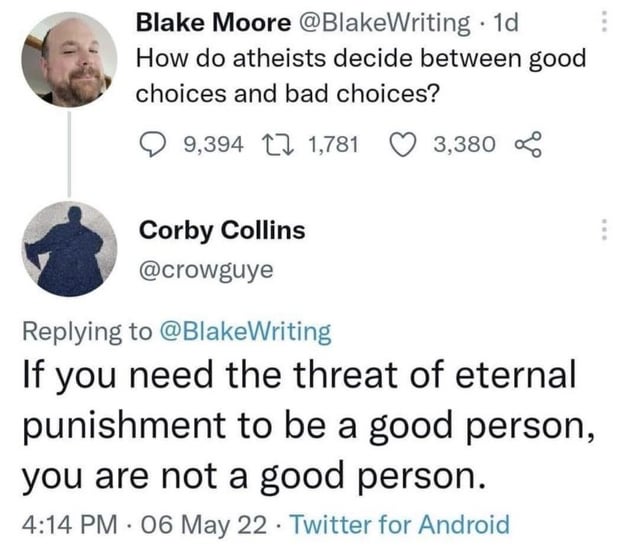
I mean, if you believe their stories, god told the first lie. so why would you believe his divinely inspired horror novel when it says someone is the bad guy?
(good news- the exodus never happened. you’d think that rivers turning to blood would be something somebody in egypt would have mentioned/written down. Or the frogs. or the locusts or the whole slew of dead first born sons.)
Not to get into a debate, but someone did write about (something that could reasonably be) it, potential motivated reasoning by the source aside. Sources from that far into the past (or even the relatively closer past) very rarely survive to the present day, especially literary sources (which tend to be written on papyrus that rots away), and even historians of relatively well-attested periods like Rome and Classical Greece basically have a few texts they rely on*, supplemented with archeology, epigraphy (inscriptions on stone) and straight up magic, and that’s a thousand years before (edit: after) the period in which the Exodus is taken to have happened without the advantage of Medieval monks painstakingly preserving the material. Now the Egyptian corpus is uncommonly big (yay for the Sahara), but it’s also very fragmented. For the most part what we don’t and can’t know is orders of magnitude more than what we can know, and it’s not even like we’ve studied the whole Egyptian corpus (we haven’t; there’s a shortage of trained Egyptologists able to do that work), so it’s very plausible that an event of even that magnitude would just… not show up in a way we can recognize. So what I want to say is: Truth of the Exodus aside, our sources for ancient history are nowhere near that comprehensive. Three thousand years is a long time.
*For example Roman military history basically entirely relies on two guys (Livy and Polybius), whose works very frustratingly only survive in part, supplemented by some less reliable sources and fragments. When talking about Alexander the Great it’s basically just Arrian, again supplemented by less reliable/comprehensive sources and fragments. And it can get worse; we get straight up nothing in the way of literature from Carthage. There’s a lot of dumb luck involved in what does and does not survive.


I mean, if you believe their stories, god told the first lie. so why would you believe his divinely inspired horror novel when it says someone is the bad guy?
(good news- the exodus never happened. you’d think that rivers turning to blood would be something somebody in egypt would have mentioned/written down. Or the frogs. or the locusts or the whole slew of dead first born sons.)
Not to get into a debate, but someone did write about (something that could reasonably be) it, potential motivated reasoning by the source aside. Sources from that far into the past (or even the relatively closer past) very rarely survive to the present day, especially literary sources (which tend to be written on papyrus that rots away), and even historians of relatively well-attested periods like Rome and Classical Greece basically have a few texts they rely on*, supplemented with archeology, epigraphy (inscriptions on stone) and straight up magic, and that’s a thousand years
before(edit: after) the period in which the Exodus is taken to have happened without the advantage of Medieval monks painstakingly preserving the material. Now the Egyptian corpus is uncommonly big (yay for the Sahara), but it’s also very fragmented. For the most part what we don’t and can’t know is orders of magnitude more than what we can know, and it’s not even like we’ve studied the whole Egyptian corpus (we haven’t; there’s a shortage of trained Egyptologists able to do that work), so it’s very plausible that an event of even that magnitude would just… not show up in a way we can recognize. So what I want to say is: Truth of the Exodus aside, our sources for ancient history are nowhere near that comprehensive. Three thousand years is a long time.*For example Roman military history basically entirely relies on two guys (Livy and Polybius), whose works very frustratingly only survive in part, supplemented by some less reliable sources and fragments. When talking about Alexander the Great it’s basically just Arrian, again supplemented by less reliable/comprehensive sources and fragments. And it can get worse; we get straight up nothing in the way of literature from Carthage. There’s a lot of dumb luck involved in what does and does not survive.