
cross-posted from: https://lemmings.world/post/43676261
Finally found some good news this morning.
We could really use more good news focused communities on Piefed/Lemmy
Note that this article is from 2 April 2026, so by now the number could be even higher.
Actually, no.
Not at all:
The AI infrastructure buildout is entering a new phase: Tech companies are doubling down on AI.
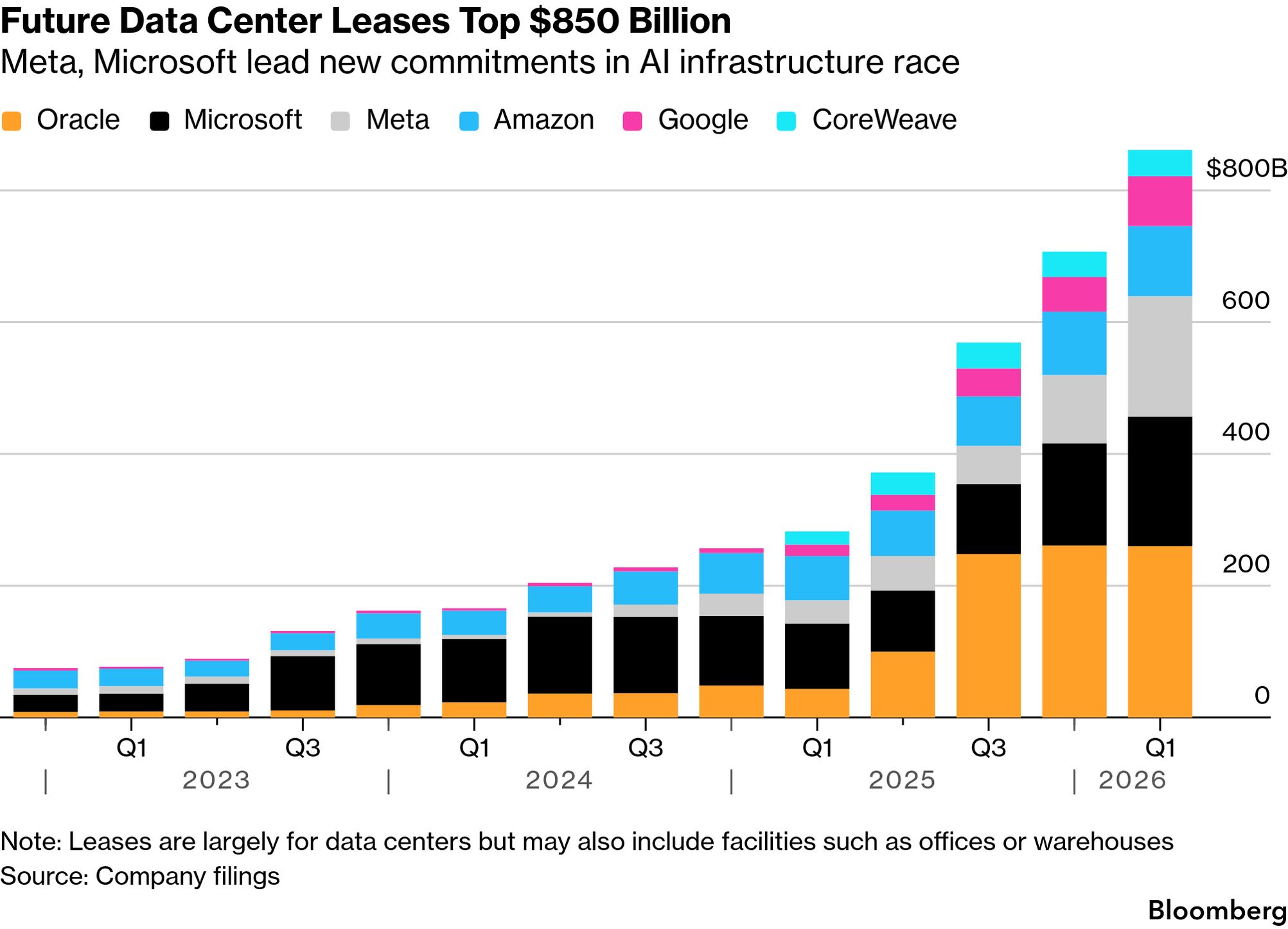
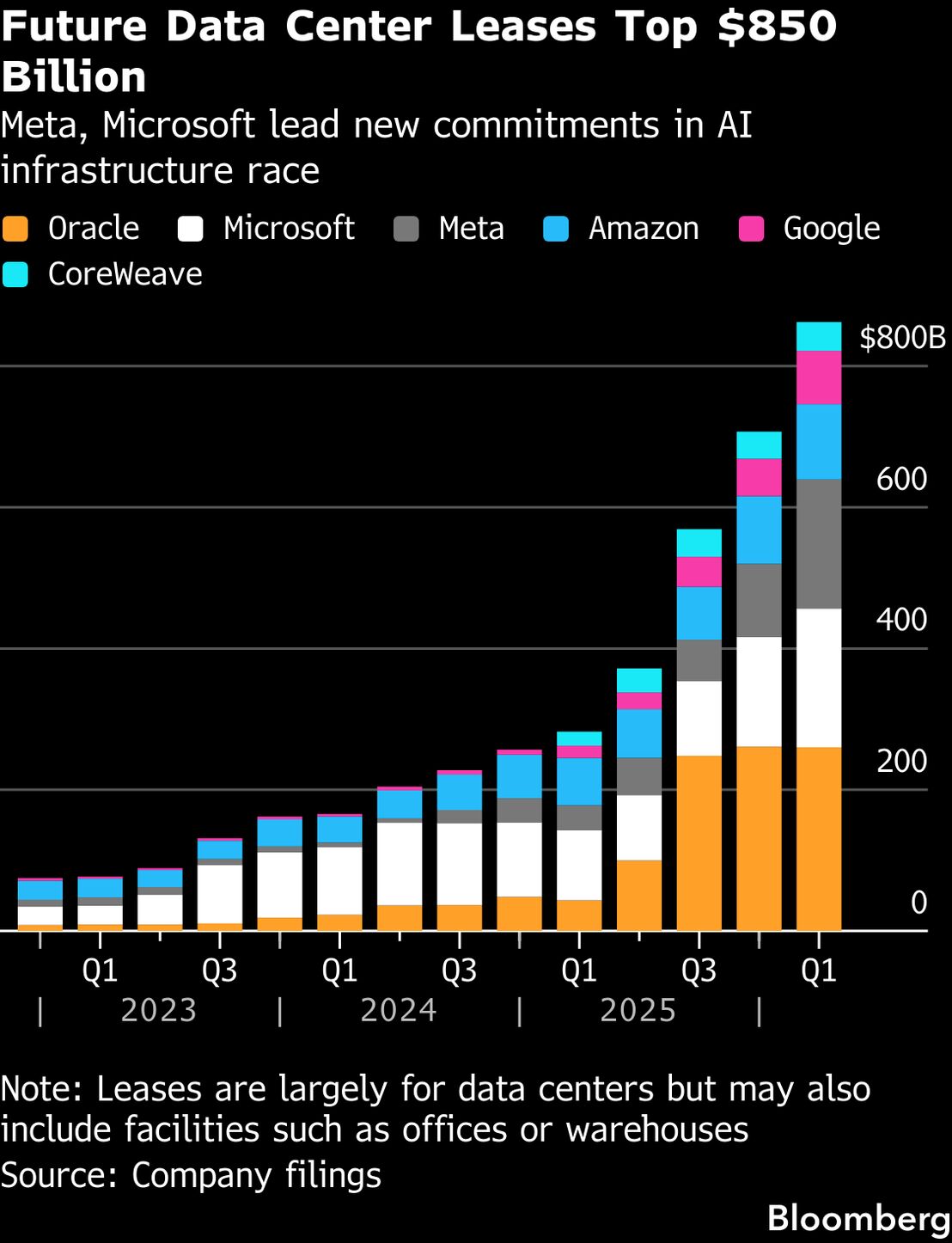
Graph Source: Bloomberg.
US tech companies are committing to spend a record $850 billion on data center leases over the next several years.
This marks a +$570 billion YoY increase, or +204%, and +$200 billion QoQ increase, or +31%.
Meta, $META, added the most in Q1 2026, committing +$79 billion in new leases, a +76% QoQ increase, bringing its total to ~$183 billion.
At the same time, Microsoft, $MSFT, added +$41 billion, a +26% QoQ increase, bringing its total to ~$197 billion.
Oracle leads with the largest total commitments at ~$250 billion, having already secured many of the key sites needed to fulfill its contract with OpenAI.
Source: The Kobeissi Letter.
Oh beep. I’m glad you brought data and sources and it was well-researched but did it have to be bad news?
Almost half? nowhere near enough. We gotta get to it being “all”.
Exactly. Those are rookie numbers keep working together and getting more people active as a collective unit!!! Power to the people!!!
Also we want our damn RAM and pre-Trump lower prices back!!! We will get there in time!!
We can do better!
Good start

Here’s hoping that the bubble pops. I want to fill my machine with RDIMMs, and swap all of my SATA SSDs with 8tb 2280s.
I’m telling you man, I can get this special oil out of this snake and it fixes everything I tried it on. It’s really rare, but I’ll let you buy some, because I think you’re smart. I wouldn’t sell it to anyone else, I’d just keep it for myself, but you get it, man.
I’ll take 3 Oils of the Snake!!! Finally, someone who recognizes my insight and commitment to enriching myself without all that foolish hard work or technical expertise.
Publication date April 2, based on reporting from Bloomberg on April 1. Anyone have an update 3 months later? I want to see what happened to the remaining half.
reporting from Bloomberg on April 1
Um …
So hardware cost will go down. Right?.. Right? :lolsob:
Of course not! Something getting cheaper for retail is a tragedy for the markets.
Some players take the mask off straight away:
The fundamental lie behind the AI fraud is that compute is scarce relative to demand. OpenAI, Grok, Meta did overinvest in hoarding GPUs far ahead of their usage. Last 2 are now competing on hourly GPU market, and AI tokens/revenue has fallen 20% since spring peak, which is a bubble pop compared to 10x/year perpetual growth expectations behind the hoarding. While hourly gpu rental market is stable rather than declining, it is stable at very low prices, mostly for accounting reasons of not actually losing money intentionally. Deployed GPUs are abundant proven by accounting floor based pricing. A b300 can deliver 8x the tokens of an h200 but only rents for 2x more.
AFAIK, it’s not “confirmed”, but there’s supposed to be warehouses full of GPUs, RAM, and storage that were pre-bought for datacentre usage, but they still have nowhere to plug them in.
For last 5 quarters, Nvidia has sold much more GPUs than get installed. On 3 year depreciation schedule, 8xh200s are $1.50/hour per card just sitting there. B200s are $2/hr. (Nvidia changes network cable each generation). Very expensive to do what you are suggesting is happening, but only other explanation is smuggling into China, or secret sovereign/military purchases.
It’s also possible that they are lent to tier 2/3 datacenters in revenue share deals.
Good start. Now for the other half.
Isn’t this one of Zitron’s oft-cited horsemen?
He’s mentioned in the third paragraph of the link. But yes, it is. In order for it to be “worth” burning a trillion dollars every year on AI, then there has to be a time in the near future, 2030 or so, where AI will be making unimaginable trillions. If the datacentres aren’t being built, then that money can’t possibly be coming in as planned. That makes the massive investment in NVidia’s GPUs look extremely shaky - why buy them if they’ll never be turned on? - and it means Oracle will be completely in the shit.
Ed’s arguments have been, “if any link in the chain fails, the whole thing falls down”. I think he’d been leaning towards “banks being unwilling to keep financing datacentre builds on debt” as the most likely stumbling block, but just being unable to power the damned things for want of infrastructure and skilled engineering, as here, is a problem he talks about frequently too.
He thinks it’s likely it’ll bring down the entire tech industry, since they’re now full of idiotic MBAs with no other big ideas. And frankly, it’s about time.
This wouldn’t be the first bubble popping do to a failure to consider the vertical infrastructure build. Heck, some analysts blame the sinking of the Titanic on substandard bolts (that is, building a ship too big and too fragile for the technology available.)
This would be a great opportunity to pump a lot of money into renewable energy and maybe even fusion R&D. (Yes, fusion often looks like a dead end, but that’s been something of a self-fulfilling prophecy, since pessimism has been slowing funding even to the best and brightest leads.)
They could have also started investing in developing cooler memory and processing units, or better systems to cool them. Instead, the data center companies just bribed officials to let them use up water (and fuck the supplies for their neighbors) thinking that the people were just going to roll over and die.
I’m all here for the green energy. I think it’s worth investing in “both sides of the coin”, though. Now that I’ve replaced all the energy-wasting bulbs in the house with LEDs, and the house is well-insulated enough that there’s just no need to run a three-bar electric fire to keep warm, then I’m at the point where solar panels would be sufficient for nearly all my energy requirements. That’s partly because solar has got better, but mainly because I’m just using loads less
On that note, the secret to not having power and cooling issues running tens of thousands of super-hot GPUs in the desert, is not to build them. Which as they’re not being built, might be enough ;-) But investing in more effort processing units and more efficient models would do it too. They wouldn’t have their “no one else can afford this” moat if it was all made more affordable, tho.
They wouldn’t have their “no one else can afford this” moat if it was all made more affordable, tho.
In a functional capitalist society (yes, those can exist, even if Marx says they’re temporary), the point would be not to provide a computing service but appliances that can perform that service. There are AI hobbyists who run open source LLM engines and retain their own dataset and bunches of LORAs. Granted it’s only terrabytes of data rather than exabytes (zettabytes? yottabytes?) and sometimes they have to let their home system brew for hours instead of minutes or seconds on a given task.
But an example of this kind of model appears in the 1970s and the invention of the personal computer, itself, before which there were only mainframes that were held by large companies (and similarly, the first PCs were hobbyist DIY kits).
I see this as a sea change driven by the same motivation that has turned large companies (who have out competed all their peers) towards enshittification. Now that we’re into the rental economy, where even software is a service rather than an appliance, the AI companies don’t want to make AI machines that they can sell, but to provide an AI service that will force their
consumer basecustomers to keep buying and keep paying.I don’t think that model can scale up. What we need to do is the same thing we did when we upgraded our secretaries from a typewriter and a Rolodex to a PC with an office software suite. Right now we’re seeing that even when we replace or reduce the human workforce with AI tools, the cost is greater than the original workforce (though for now, that cost is borne by the AI companies at a loss, rather than their downstream clients).
Instead we should be developing AI computer systems at the mainframe and PC level as tools to facilitate workers, which would (we hope) increase their productivity.
But again, our conglomerate corporations are trying to shore up their dominant positions in the economy, and so, as Cory Doctorow observed, are trying to do a blanket replacement of their workforce, which is failing spectacularly.
RANT: And since our ownership class and C-suite management have demonstrated they refuse to engage in commerce in good faith, seeking to replace competitive production with rent, lobbying government and financial shenanigans, the public needs to recapture government – by force
asif necessary – to go back to regulating commerce and protecting workers and consumers alike. History has shown that this can create an economic environment that is fecund for benevolent innovation, e.g. better stuff for everyone.
So that means PC component prices will fall, right?
Right?
they won’t fall until AI companies cancel their purchasing contracts
Is that the sound of a needle contacting a bubble I hear?