You keep trying to change the argument from the lack of fairness in tax policy to a discussion of how you can dodge taxes by becoming a business.
Yes by becoming a business you can dodge taxes like other businesses. That’s not the argument.
OP: “rent is high”
YOU: “no its not, just buy a house”
OP: “that’s not what I said”
YOU: “You’re not listening, here are tips to buy a house cheaply.”
You buying a house cheap doesn’t change that the OP said rent is high.
Becoming a business doesn’t change the tax policy allows deductions for businesses that employees don’t get.
And your “garage sale tip” is bullshit of the highest order. If you’ve done it, you are lucky you haven’t been audited. You can’t deduct on a loss every year without being classified as a hobby. If you are holding a garage sale, you aren’t earning a profit- that’s why its not taxable. You selling a 20 year old $10 beanie baby for 25 cents is a loss and you don’t have to pay taxes on that 25 cents.
And your “garage sale tip” is bullshit of the highest order.
I completely agree. It is bullshit of the highest order. There is a special IRS term for “bullshit of the highest order”. That term is “business”.
If you’ve done it, you are lucky you haven’t been audited.
If I had done that, and I was audited, and the IRS had a problem with it. I’d owe what I would have owed anyway. Maybe with a small penalty.
You can’t deduct on a loss every year without being classified as a hobby.
How many companies do you need me to name, and how many years do they need to show losses? You certainly can show several consecutive years of losses. You’d be hard pressed to find a company that hasn’t shown many consecutive years of losses. Lack of profit doesn’t mean a business is unsuccessful. It means they paid out their vendors and workers and creditors a bit more than they brought in.
And why do you assume you will always show losses? Why do you assume you won’t find a profitable niche in the process? The only requirement the IRS needs to classify you as a business is the fact that you don’t make an assumption like that. That assumption is what makes it a hobby. Don’t make it, and you’re a business.
Small penalty is when you make a mistake. Gigantic deductions with no income would have them charging you with tax fraud. The lawyer fees to defend yourself would be worse than the penalties.
Lack of profit doesn’t mean a business is unsuccessful
Companies like Amazon showed losses a decade because they had income from investors. So they had income, it was only that
the “business” side of the business was unprofitable.
You can’t get away with deducting your mortgage as a business express from a unprofitable garage sale. Certainly not year after year.
Why do you assume you won’t find a profitable niche in the process?
So we are back to, “just buy a house if you can’t afford rent.”
Gigantic deductions with no income would have them charging you with tax fraud.
Tax fraud would be claiming deductions for expenses that were never incurred. The expense of “rent” was incurred. The expense of “posterboard” was incurred. The expense of “balloons” was incurred. Using your attic for something other than storing items you retail in your online store and garage sale would turn your claim into fraud, but I never suggested you should do anything like that. That you attempted to sell everything in your attic indicates it was not used for personal use. They may not allow you to claim it as a business expense, but they can’t argue fraud unless you used it for personal use despite claiming business. So don’t do that. Don’t use it for personal use when you claim it as a business use.
You can’t get away with deducting your mortgage as a business express from a unprofitable garage sale.
I didn’t say deduct your entire mortgage. You can’t do that, unless you use the entire home exclusively for business. But you certainly can deduct a part of your mortgage, a part proportional to the amount of your house you use exclusively for business.
So we are back to, “just buy a house if you can’t afford rent.”
What are you talking about? That doesn’t make any sense whatsoever, and it certainly doesn’t arise from my arguments.
Look, you’re entering into this from the assumption that I’m suggesting you defraud the government. That is completely untrue. What I am saying is that “business” is a much broader category than you seem to think. A garage sale can certainly be a business activity. Re-selling merchandise online can certainly be a business activity. There is no explicitly defined line on how many business activities you need to perform, nor a explicit time period in which you need to perform them in order to consider yourself a business. As long as you approach it with the intention of (eventually) becoming profitable - even if you can’t figure out how to do that right now - it is a business, and you are entitled to claim it as such.
It is the epitome of foolishness to conduct business activities without declaring them to be “business”.
You aren’t even googling before making shit up now.
Dude. You are clearly not understanding me. My statement - that you specifically quoted above - summarizes each and every point your link makes. You act like you’re disagreeing with me, but you’re supporting points I’ve already made. The disagreement you are having on this issue is entirely within your own head.
For example, from your link:
If the IRS believes you have erroneously claimed a home office or other deduction, it can ding you for anywhere between $500 and $5,000. This penalty can jump to 75% if the taxpayer deliberately and fraudulently attempts to reduce their tax liability.
My previous statement (Emphasis added):
They may not allow you to claim it as a business expense, but they can’t argue fraud unless you used it for personal use despite claiming business. So don’t do that. Don’t use it for personal use when you claim it as a business use.
Your link is just quantifying the penalties for ignoring my advice. Don’t “erroneously claim a home office or other deduction”. Go ahead and claim them, just make sure your claim isn’t erroneous. You are perfectly entitled to make a valid claim.
I’m entering this from the assumption that you are steering the argument into something completely unrelated because you were proven wrong.
That might just be a piss-poor assumption. You should probably go back and see if that assumption is actually justified. (Narrator: It wasn’t.)
IT DOESN’T MATTER IF YOU CAN LEGALLY DODGE TAXES BY RUNNING A BUSINESS. THE OP STATED THAT W2 EMPLOYEES DON’T GET THE DEDUCTIONS OF A BUSINESS.
This would only be a valid statement if “being a W2 employee” precluded the individual from also running their own business. As the employee is not precluded from running a business, the W2 employee can get the deductions of running a business. You have no grounds to say that they can’t get the deductions of a business, when they can, in fact, get the deductions of a business simply by operating as a business.
Perhaps it would be useful to show you that a business is not always entitled to deduct something. For example, where a business (subcontractor) is hired by another business (prime contractor) and that prime contractor provides various direct compensation to the sub, the sub cannot deduct the expense in question. The subcontractor is, effectively, an employee of the prime contractor, even though both are businesses. Expenses made by the prime cannot be deducted by the sub. Remember that.
If the prime contractor provides eye protection and other PPE to the subcontractor, the subcontractor cannot deduct that PPE as a business expense. If the prime contractor provides transportation to and from the main job site, the subcontractor cannot claim transportation costs.
When you cannot claim your commute costs as a W2 employee, it is because the IRS requires those costs to be included in your negotiated direct compensation with your employer. Your pay specifically includes compensation for your normal commute. You are “reimbursed” for your normal commute costs, and don’t get to claim them yourself.
As a W2 employee, you can claim transportation costs to other job sites unless you are specifically reimbursed for your travel to those other job sites. If you are reimbursed, you don’t also get to claim it. Your employer gets to claim that reimbursement as a deductible expense.
If you don’t like that, don’t work as a W2 employee. Work as a contractor: a business. A contractor is allowed to deduct the expense of all non-reimbursed transportation costs, and is not expected or required to demand explicit reimbursement for transportation or other expenses in their negotiated fee.
Fraud can be overstated deductions. Given that you aren’t allowed to deduct your mortgage for a garage sale, and you are doing it every year to offset your W2 earnings, the amount of your phony deduction could be considered fraud. You can’t deduct hobby expenses.
If you don’t like that, don’t work as a W2 employee
That’s not the discussion and you know it.
“Rent is high” you: “buy a house”
“Police are corrupt” you: “become a policeman”
“Tax policy is unfair” you: “start a successful business”
you claimed you could deduct part of your mortgage for a garage sale.
I claimed that a garage sale was a business activity. I said if you didn’t think an annual garage sale was sufficient to count as a “business”, you could engage in online retailing or other additional activities as well.
You absolutely are allowed to deduct the costs for that part of your home you use exclusively for business purposes. Right from your own link:
"Part 1—Part of Your Home Used for Business
Lines 1–3.
If you figure the percentage based on area, use lines 1 through 3 to figure the business-use percentage. Enter the percentage on line 3.
You can use any other reasonable method that accurately reflects your business-use percentage. If you operate a daycare facility and you meet the exception to the exclusive use test for part or all of the area you use for business, you must figure the business-use percentage for that area as explained under Daycare Facility, earlier. If you use another method to figure your business percentage, skip lines 1 and 2 and enter the percentage on line 3.
I’m beginning to get offended at the repeated insinuations that I am advocating fraud. You are looking at BUSINESS ACTIVITIES and declaring them to be fraud. You’ve adopted some sort of weird victim mentality here. You think that if “businesses” do it, it’s permitted by the government, but if you do the exact same thing, it’s fraud. It’s not.
Have you ever worked as a 1099 contractor? Have you ever had any income whatsoever that didn’t come from a W2 or capital gains? It really doesn’t seem like it. Your position on what constitutes a “business” seems to be some kind of megacorporation, rather than a sole proprietorship. You seem to be under the impression that unless you can survive off the income of your business, it’s not a business at all.
Fraud can be overstated deductions.
I never suggested overstating deductions. Your argument here is bordering on libelous.
Given that you aren’t allowed to deduct your mortgage for a garage sale,
Your own link says otherwise.
the amount of your phony deduction could be considered fraud.
There was no phony deduction.
You can’t deduct hobby expenses.
True, but I never suggested a hobby. I suggested a business. And I described numerous activities - not just a garage sale - that would constitute business. You consistently ignore the remainder of my argument: if you don’t think a garage sale is sufficient to constitute a “business”, you can engage in online retailing and other activities as well.
“Rent is high” you: “buy a house” “Police are corrupt” you: “become a policeman” “Tax policy is unfair” you: “start a successful business”
Your first two points don’t arise from any of my arguments. As for the third, I never said “start a successful business”. I’ve said repeatedly that 30% of home businesses never show a profit. They still get to deduct their expenses. Your third observation would be better stated as “Businesses get unfair tax breaks” : “Start a business, so you an claim the same tax breaks”
That’s not the discussion and you know it.
Actually, it is the entire discussion. The fact that the IRS requires your regular commute and other expenses to be included in your negotiated pay as a W2 employee means that your expenses are effectively considered “reimbursed”. Businesses don’t get to claim reimbursed expenses as deductions. If you don’t want to include such expenses in your regular pay, you can work as a 1099 contractor rather than a W2 employee.
I claimed that a garage sale was a business activity.
You can’t deduct housing for a garage sale as you claimed.
The fact that the IRS requires your regular commute and other expenses to be included in your negotiated pay as a W2 employee means that your expenses are effectively considered “reimbursed”.
They specifically say you can’t deduct even if the employer doesn’t reimburse.
“Employees can’t deduct this cost even if their employer doesn’t reimburse the employee for using their own car.”


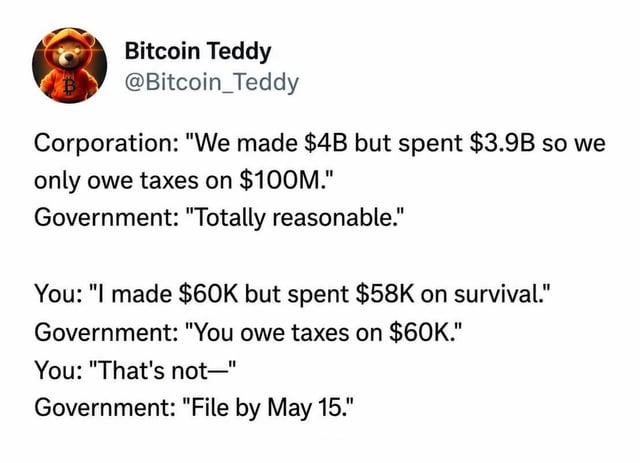
You keep trying to change the argument from the lack of fairness in tax policy to a discussion of how you can dodge taxes by becoming a business.
Yes by becoming a business you can dodge taxes like other businesses. That’s not the argument.
OP: “rent is high” YOU: “no its not, just buy a house” OP: “that’s not what I said” YOU: “You’re not listening, here are tips to buy a house cheaply.”
You buying a house cheap doesn’t change that the OP said rent is high. Becoming a business doesn’t change the tax policy allows deductions for businesses that employees don’t get.
And your “garage sale tip” is bullshit of the highest order. If you’ve done it, you are lucky you haven’t been audited. You can’t deduct on a loss every year without being classified as a hobby. If you are holding a garage sale, you aren’t earning a profit- that’s why its not taxable. You selling a 20 year old $10 beanie baby for 25 cents is a loss and you don’t have to pay taxes on that 25 cents.
I completely agree. It is bullshit of the highest order. There is a special IRS term for “bullshit of the highest order”. That term is “business”.
If I had done that, and I was audited, and the IRS had a problem with it. I’d owe what I would have owed anyway. Maybe with a small penalty.
How many companies do you need me to name, and how many years do they need to show losses? You certainly can show several consecutive years of losses. You’d be hard pressed to find a company that hasn’t shown many consecutive years of losses. Lack of profit doesn’t mean a business is unsuccessful. It means they paid out their vendors and workers and creditors a bit more than they brought in.
And why do you assume you will always show losses? Why do you assume you won’t find a profitable niche in the process? The only requirement the IRS needs to classify you as a business is the fact that you don’t make an assumption like that. That assumption is what makes it a hobby. Don’t make it, and you’re a business.
Small penalty is when you make a mistake. Gigantic deductions with no income would have them charging you with tax fraud. The lawyer fees to defend yourself would be worse than the penalties.
Companies like Amazon showed losses a decade because they had income from investors. So they had income, it was only that the “business” side of the business was unprofitable.
You can’t get away with deducting your mortgage as a business express from a unprofitable garage sale. Certainly not year after year.
So we are back to, “just buy a house if you can’t afford rent.”
Tax avoidance schemes isn’t the argument.
Tax fraud would be claiming deductions for expenses that were never incurred. The expense of “rent” was incurred. The expense of “posterboard” was incurred. The expense of “balloons” was incurred. Using your attic for something other than storing items you retail in your online store and garage sale would turn your claim into fraud, but I never suggested you should do anything like that. That you attempted to sell everything in your attic indicates it was not used for personal use. They may not allow you to claim it as a business expense, but they can’t argue fraud unless you used it for personal use despite claiming business. So don’t do that. Don’t use it for personal use when you claim it as a business use.
I didn’t say deduct your entire mortgage. You can’t do that, unless you use the entire home exclusively for business. But you certainly can deduct a part of your mortgage, a part proportional to the amount of your house you use exclusively for business.
What are you talking about? That doesn’t make any sense whatsoever, and it certainly doesn’t arise from my arguments.
Look, you’re entering into this from the assumption that I’m suggesting you defraud the government. That is completely untrue. What I am saying is that “business” is a much broader category than you seem to think. A garage sale can certainly be a business activity. Re-selling merchandise online can certainly be a business activity. There is no explicitly defined line on how many business activities you need to perform, nor a explicit time period in which you need to perform them in order to consider yourself a business. As long as you approach it with the intention of (eventually) becoming profitable - even if you can’t figure out how to do that right now - it is a business, and you are entitled to claim it as such.
It is the epitome of foolishness to conduct business activities without declaring them to be “business”.
You aren’t even googling before making shit up now.
https://gordonlaw.com/learn/taking-too-many-deductions/#%3A~%3Atext=Sometimes+called+“padding%2C”+typical+overstating+deductions+tactics+include%2Ccharge+parties+who+overstate+deductions+with+tax+fraud.
I’m entering this from the assumption that you are steering the argument into something completely unrelated because you were proven wrong.
IT DOESN’T MATTER IF YOU CAN LEGALLY DODGE TAXES BY RUNNING A BUSINESS. THE OP STATED THAT W2 EMPLOYEES DON’T GET THE DEDUCTIONS OF A BUSINESS.
Dude. You are clearly not understanding me. My statement - that you specifically quoted above - summarizes each and every point your link makes. You act like you’re disagreeing with me, but you’re supporting points I’ve already made. The disagreement you are having on this issue is entirely within your own head.
For example, from your link:
My previous statement (Emphasis added):
Your link is just quantifying the penalties for ignoring my advice. Don’t “erroneously claim a home office or other deduction”. Go ahead and claim them, just make sure your claim isn’t erroneous. You are perfectly entitled to make a valid claim.
That might just be a piss-poor assumption. You should probably go back and see if that assumption is actually justified. (Narrator: It wasn’t.)
This would only be a valid statement if “being a W2 employee” precluded the individual from also running their own business. As the employee is not precluded from running a business, the W2 employee can get the deductions of running a business. You have no grounds to say that they can’t get the deductions of a business, when they can, in fact, get the deductions of a business simply by operating as a business.
Perhaps it would be useful to show you that a business is not always entitled to deduct something. For example, where a business (subcontractor) is hired by another business (prime contractor) and that prime contractor provides various direct compensation to the sub, the sub cannot deduct the expense in question. The subcontractor is, effectively, an employee of the prime contractor, even though both are businesses. Expenses made by the prime cannot be deducted by the sub. Remember that.
If the prime contractor provides eye protection and other PPE to the subcontractor, the subcontractor cannot deduct that PPE as a business expense. If the prime contractor provides transportation to and from the main job site, the subcontractor cannot claim transportation costs.
When you cannot claim your commute costs as a W2 employee, it is because the IRS requires those costs to be included in your negotiated direct compensation with your employer. Your pay specifically includes compensation for your normal commute. You are “reimbursed” for your normal commute costs, and don’t get to claim them yourself.
As a W2 employee, you can claim transportation costs to other job sites unless you are specifically reimbursed for your travel to those other job sites. If you are reimbursed, you don’t also get to claim it. Your employer gets to claim that reimbursement as a deductible expense.
If you don’t like that, don’t work as a W2 employee. Work as a contractor: a business. A contractor is allowed to deduct the expense of all non-reimbursed transportation costs, and is not expected or required to demand explicit reimbursement for transportation or other expenses in their negotiated fee.
you claimed you could deduct part of your mortgage for a garage sale.
You claimed it isn’t fraud if you can show the source.
You aren’t allowed to deduct your mortgage for a garage sale.
https://www.irs.gov/publications/p587
Fraud can be overstated deductions. Given that you aren’t allowed to deduct your mortgage for a garage sale, and you are doing it every year to offset your W2 earnings, the amount of your phony deduction could be considered fraud. You can’t deduct hobby expenses.
That’s not the discussion and you know it.
“Rent is high” you: “buy a house” “Police are corrupt” you: “become a policeman” “Tax policy is unfair” you: “start a successful business”
I claimed that a garage sale was a business activity. I said if you didn’t think an annual garage sale was sufficient to count as a “business”, you could engage in online retailing or other additional activities as well.
You absolutely are allowed to deduct the costs for that part of your home you use exclusively for business purposes. Right from your own link:
I’m beginning to get offended at the repeated insinuations that I am advocating fraud. You are looking at BUSINESS ACTIVITIES and declaring them to be fraud. You’ve adopted some sort of weird victim mentality here. You think that if “businesses” do it, it’s permitted by the government, but if you do the exact same thing, it’s fraud. It’s not.
Have you ever worked as a 1099 contractor? Have you ever had any income whatsoever that didn’t come from a W2 or capital gains? It really doesn’t seem like it. Your position on what constitutes a “business” seems to be some kind of megacorporation, rather than a sole proprietorship. You seem to be under the impression that unless you can survive off the income of your business, it’s not a business at all.
I never suggested overstating deductions. Your argument here is bordering on libelous.
Your own link says otherwise.
There was no phony deduction.
True, but I never suggested a hobby. I suggested a business. And I described numerous activities - not just a garage sale - that would constitute business. You consistently ignore the remainder of my argument: if you don’t think a garage sale is sufficient to constitute a “business”, you can engage in online retailing and other activities as well.
Your first two points don’t arise from any of my arguments. As for the third, I never said “start a successful business”. I’ve said repeatedly that 30% of home businesses never show a profit. They still get to deduct their expenses. Your third observation would be better stated as “Businesses get unfair tax breaks” : “Start a business, so you an claim the same tax breaks”
Actually, it is the entire discussion. The fact that the IRS requires your regular commute and other expenses to be included in your negotiated pay as a W2 employee means that your expenses are effectively considered “reimbursed”. Businesses don’t get to claim reimbursed expenses as deductions. If you don’t want to include such expenses in your regular pay, you can work as a 1099 contractor rather than a W2 employee.
You can’t deduct housing for a garage sale as you claimed.
They specifically say you can’t deduct even if the employer doesn’t reimburse.
“Employees can’t deduct this cost even if their employer doesn’t reimburse the employee for using their own car.”
https://www.irs.gov/newsroom/heres-the-411-on-who-can-deduct-car-expenses-on-their-tax-returns
So the IRS does not consider your salary as including reimbursement for transportation.
“you can work as a 1099 contractor rather than a W2 employee.”
Companies do not offer that choice to everyone.