Sadly, they were just repeating the same old points. Weirdly, their justification for why it was fine to use dude in that context would make Sir a gender neutral term.
Like the other comment you replied to says: people will say the silliest things instead of introspect. It’s all post hoc- “I do this thing, what do I need to say I believe to make that ok.”
So i had fun repeating their ideas back at them, which is what I said I do in my original comment. Then people got upset at hearing their own ideas, like I said they do in my original comment.
Wait you believe dude is gender neutral? Your mum/wife/girlfriend/sister you think they’re all dudes? Weird. Wait you believe he/him is gender neutral because it’s used in that context? Weird. Wait, you believe Sir is gender neutral because it’s used in a specific case gender neutrally? Weird…
For example here’s a comment I received:
I don’t think I’ve ever heard “language changes over time and that’s sexist and toxic” from anyone other than Latin teachers with no students
There isn’t a point here beyond a misread. No, the fact that language changes doesn’t make it sexist and toxic. We used to use gendered terms for men for everyone: he/him in all the manuals. Why? Some people still use gendered terms for men for everyone: dude. Why? I suggest they’re for the same reason. But we can’t get to that step without first realising that dude is a gendered term.
Anyway, They just do this thing, so need to believe that language isn’t criticised in this way by anyone other than Latin teachers with no students. Despite a link to that thing happening in the very thread they’re replying to: the project to replace he/him I linked to. It’s just silliness so they don’t have to introspect. Funny though.
A small excerpt:
Today, we live in a very different world. In the intervening decades, society, and its language, has become more inclusive. The tone of TV comedies has changed, the percentage of women inventors worldwide (though still small) has more than doubled, the need for gender neutral, non-sexist language has been recognised. The time had come for our trusty MoPP, the essential ‘go to’ for every patent examiner, to change.
They’re all Latin teachers with no students, or of similar ilk to Latin teachers with no students? All of them? Every industry that changed their manuals from he/him to they/them? You really believe that? Weird.
Unfortunately, you think I’m right and that it is weird, but continue to include it as an option in your list. If someone told me what I was doing was weird, and I agreed with them, I wouldn’t keep it as an option and point out “yeah, but I know other less weird ones”. Just use the less weird ones.
That’s what you took from that? I provided a big list for various contexts and that’s what you focus on? Anyway:
“A dude cut in front of me in line” did you happen to note what you pictured when you thought of a dude cutting in front of you? Assuming you don’t have aphantasia.
“A person cut in front of me in line” both acceptable sentences in English.
A dude called me, a person called me. I met a dude the other day, I met a person the other day. I’d rather be in the forest with a bear than a person, I’d rather be in the forest with a bear than a dude.
Let’s do plurals: 3 people walked into a bar, 3 dudes walked into a bar (they said ‘ouch’).
If you think “person” is weird ommit it. It’s a distinction without difference as it’s lack doesn’t change my point in any way, shape, or form. This is what’s called pettifogging, when even if you’re right it doesn’t change a thing.
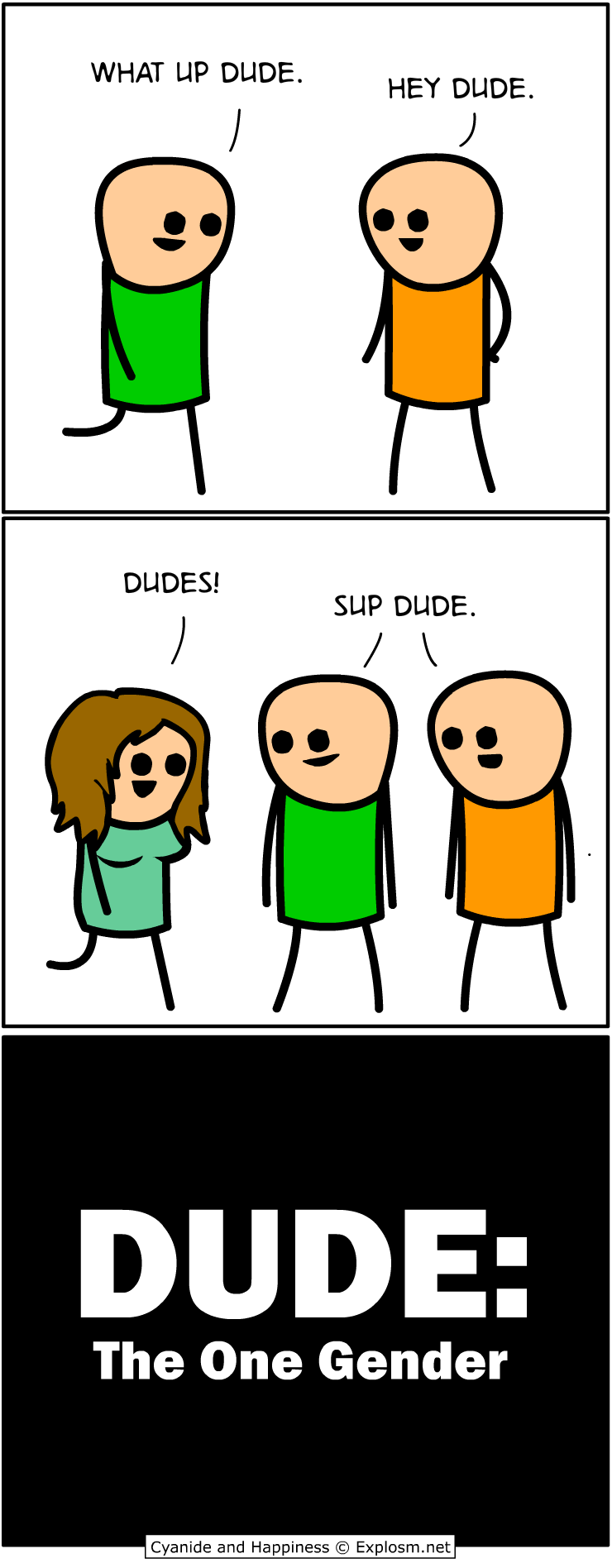
When Dude is directed AT someone (“Hey, Dude!”), it’s definitely gender neutral. And when using it at the beginning of the sentence, it’s just an exclamation like Damn, Shit, or God (“Dude, that was crazy”).
You’re changing the terms of how the conversation started. OP explicitly framed this conversation as direct engagement with another person (vocative noun), not about referring to them as an object within the sentence (general noun).
Read the rest of the thread please. You’re rehashing old lines that have been discussed already.
Someone else makes the argument that’s it’s the context that makes it gender neutral. I pointed out that he/him were, in the context of instruction manuals, used as a catch all term, and asked if they believed he/him are gender neutral.
I’ll make it real easy: in the before times we used he/him as a default term to reference people, then we realised he/him is a gendered term and not suitable as a default way to reference people [2]. Fast forward to the now time: some people use dude as a default term, but now people are learning dude is a gendered term[1]…
The 1 and 2 are pointing out 1 everyone agreed dude was gendered barring this one, apparently magical, context. And 2 he/him was used in manuals as the default.
My argument is that the context isn’t magical, and we’re just repeating history.
I added more context, my nazi quoting old man still heads his letter “Dear Sirs” do you believ Sir is gender neutral? He knows he might be addressing a woman… Doesn’t give a shit. He’s using ‘dear sirs’ to directly address someone: addressed to manager of bank, headed dear sirs. Is that the magical context that makes you believe sirs is gender neutral? I think it might be. Do you now believe sirs is gender neutral, or are we perhaps just repeating history?


Me:
You’re right, fortunately I provided a bunch of options for any number of contexts and even left room for more.
Wow that was you? Thanks Mr language man
It was a weird bit of pettifogging.
Sadly, they were just repeating the same old points. Weirdly, their justification for why it was fine to use dude in that context would make Sir a gender neutral term.
Like the other comment you replied to says: people will say the silliest things instead of introspect. It’s all post hoc- “I do this thing, what do I need to say I believe to make that ok.”
So i had fun repeating their ideas back at them, which is what I said I do in my original comment. Then people got upset at hearing their own ideas, like I said they do in my original comment.
Wait you believe dude is gender neutral? Your mum/wife/girlfriend/sister you think they’re all dudes? Weird. Wait you believe he/him is gender neutral because it’s used in that context? Weird. Wait, you believe Sir is gender neutral because it’s used in a specific case gender neutrally? Weird…
For example here’s a comment I received:
There isn’t a point here beyond a misread. No, the fact that language changes doesn’t make it sexist and toxic. We used to use gendered terms for men for everyone: he/him in all the manuals. Why? Some people still use gendered terms for men for everyone: dude. Why? I suggest they’re for the same reason. But we can’t get to that step without first realising that dude is a gendered term.
Anyway, They just do this thing, so need to believe that language isn’t criticised in this way by anyone other than Latin teachers with no students. Despite a link to that thing happening in the very thread they’re replying to: the project to replace he/him I linked to. It’s just silliness so they don’t have to introspect. Funny though.
A small excerpt:
Just one example, there’s plenty of others
They’re all Latin teachers with no students, or of similar ilk to Latin teachers with no students? All of them? Every industry that changed their manuals from he/him to they/them? You really believe that? Weird.
Unfortunately, you think I’m right and that it is weird, but continue to include it as an option in your list. If someone told me what I was doing was weird, and I agreed with them, I wouldn’t keep it as an option and point out “yeah, but I know other less weird ones”. Just use the less weird ones.
That’s what you took from that? I provided a big list for various contexts and that’s what you focus on? Anyway:
“A dude cut in front of me in line” did you happen to note what you pictured when you thought of a dude cutting in front of you? Assuming you don’t have aphantasia.
“A person cut in front of me in line” both acceptable sentences in English.
A dude called me, a person called me. I met a dude the other day, I met a person the other day. I’d rather be in the forest with a bear than a person, I’d rather be in the forest with a bear than a dude.
Let’s do plurals: 3 people walked into a bar, 3 dudes walked into a bar (they said ‘ouch’).
If you think “person” is weird ommit it. It’s a distinction without difference as it’s lack doesn’t change my point in any way, shape, or form. This is what’s called pettifogging, when even if you’re right it doesn’t change a thing.
You’re changing the terms of how the conversation started. OP explicitly framed this conversation as direct engagement with another person (vocative noun), not about referring to them as an object within the sentence (general noun).
Read the rest of the thread please. You’re rehashing old lines that have been discussed already.
Someone else makes the argument that’s it’s the context that makes it gender neutral. I pointed out that he/him were, in the context of instruction manuals, used as a catch all term, and asked if they believed he/him are gender neutral.
The 1 and 2 are pointing out 1 everyone agreed dude was gendered barring this one, apparently magical, context. And 2 he/him was used in manuals as the default.
My argument is that the context isn’t magical, and we’re just repeating history.
I added more context, my nazi quoting old man still heads his letter “Dear Sirs” do you believ Sir is gender neutral? He knows he might be addressing a woman… Doesn’t give a shit. He’s using ‘dear sirs’ to directly address someone: addressed to manager of bank, headed dear sirs. Is that the magical context that makes you believe sirs is gender neutral? I think it might be. Do you now believe sirs is gender neutral, or are we perhaps just repeating history?