

1·
2 years agoBut you’d have to go outside the walls to get to the turrets. And you’re in a situation where you have someone who can cast 8th level spells. I’m not sure this advice is sound. 🤨
But you’d have to go outside the walls to get to the turrets. And you’re in a situation where you have someone who can cast 8th level spells. I’m not sure this advice is sound. 🤨
You don’t even need to homebrew. Spell scrolls exist. It’s not unreasonable to think a spell scroll of mighty fortress would be stored away for safekeeping somewhere for a long time before the PCs find it. 👍🏻
Still better than the 50,000 gp construction cost and 400 days for a “Keep or small castle” using Building a Stronghold. Actual time spent on labor amounts to a minute per week for a high enough level wizard.
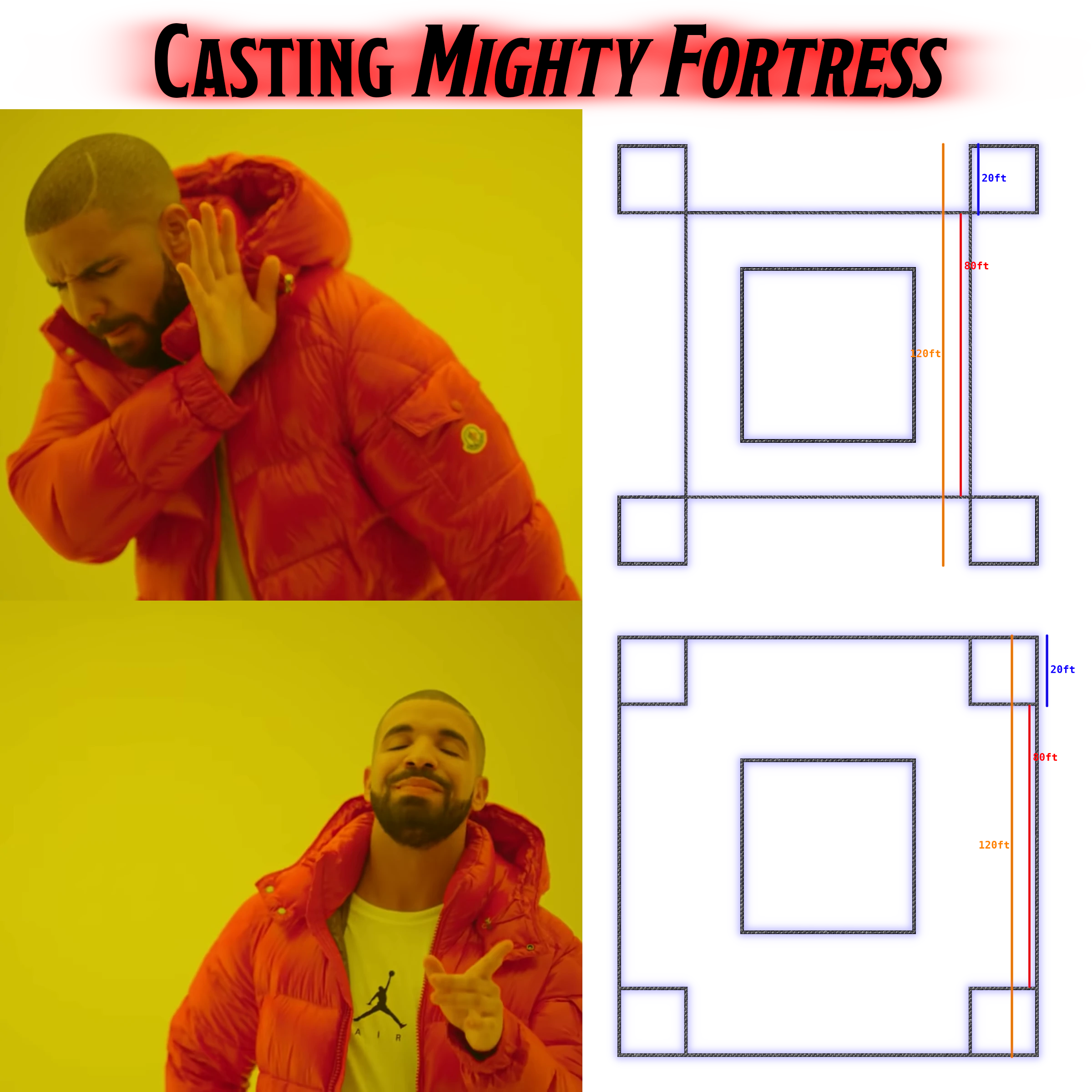
Well, technically it doesn’t say your connecting walls have to be straight, just 80 feet long. Not exactly sure how you’re going to make them connect up into a hexagon or star out of “four turrets with square bases, each one 20 feet on a side and 30 feet tall, with one turret on each corner”, but if you’ve got a diagram I’d love to see it. 😆
The spell mighty fortress is very specific about the size and shape of the castle it makes, but not about where walls are connected. Both are 120’ square areas with four 20’ turrets connected by 80’ walls, but the second one you get more interior space and can access your turrets without leaving the outer walls.
You can make it permanent if you cast it 53 times, and by the time you hit level 15, 500gp for a week of downtime with comfort and security is occasionally worth it. Our druid/cleric regularly casts greater restoration rather than wait for me to prepare remove curse the next morning.
I mean, if we’re getting very strict about RAW revivify does target a creature†, not the corpse of a creature. (Most DMs I know don’t make you hunt them down in the afterlife, or cast animate objects on their body first, but if we’re picking at technicalities I think I’m on solid footing.)
On the philosophical note, if your corpse doesn’t have the identity “you”, there’d be no way to raise “you” “yourself”. Though your objections to clone and planar ally counting as “raising yourself” are valid, but potentially debatable. I think it mostly comes down to how you define it.
The magic jar trick doesn’t rely on getting back into your body on the same turn, but even if it did, you could just push the jar off a shelf as a free interaction and break it to end the spell and return to your body. No Action Surge required.
I’m also well aware of how antimagic fields work, and (as with all aspects of the game) that it’s DM dependent. But online discussions that attempt to account for varying DM interpretations aren’t usually constructive, since some DMs can disagree about anything. I’m basing this position on the literal rules as written, and the interpretation of this very question by the official Sage Advice Compendium.
(i.e.  )
)
However, many of the control effects depend on telepathy, which according to the Monster Manual, is explicitly magical. So I agree, antimagic fields could potentially suppress control with some methods of reanimation. Dispel magic is pretty nerfed in 5e though, and only spells or things that specify they’re affected by dispel magic are dispelled or suppressed.
†Albeit with some qualifiers, but still a creature rather than an object. Which now that I’m considering it means I think the spell qualifies on a technicality for glyph of warding as well, but the “[…] it targets the creature that triggered the glyph.” clause might cause it to fail if you’re an object at the time it’s triggered.
The RAW rules actually allow you a myriad of ways to “raise yourself from the dead”.
The whole concept of liches is basically raising yourself from the dead.
Also of note; Most reanimation spells (animate dead, create undead, raise dead, etc…) are instantaneous and can’t be ended by an antimagic field or dispel magic. (The same can’t always be said for a creator’s control. The creature(s) these spells create usually don’t die/cease to be animated when the creator’s control ends either though.)
I imagine the contingency + danse macabre version, or a variant of this, is what /u/Ghost33313@kbin.social what thinking of, since it would break with loss of concentration.

All the information is on the task.