I do find it interesting how many arguments I’ll see online that rely on an idealized version of Christianity to make a point of Christianity, as though Christianity would be pure if people followed the “actual” morals. But like, this is what it is, they’re talking about a Christian church in the United States of America and the argument is that if MAGAts followed that Christianity, they’d be following “real” Christianity. Christianity was an engine of colonialism and all of the genocidal violence within it; institutions are what they do, not what they say they want to do.
I think a lot of people don’t realize that they’re making conservative, revisionist narratives when they want to privilege hypocrisy in their arguments rather than morality.
The hilarious irony is that Jesus was quite clear: the Law of Moses is eternal… therefore all the progressive christians have it wrong.
The whole “no you don’t have to get your dick chopped” thing comes from Paul… who directly contradicts Jesus on the matter.
Not even Paul said fuck all about slavery being wrong or women being actual people, and he had some very strong opinions on LGBTQ matters. (And Jesus was much worse.)
I mean, sure, but what I’m cautioning against is prescribing any normative definition or configuration of Christianity, as it then implies an idealized version is real, and therefore that the problem is that people aren’t following the religion the “right” way, not that there is something systemic that influences how the religion functions in society.
There were baptists in central Europe that allowed women to serve as pastors as early as the early modern period, which is markedly different than what Baptism is like in the US today. During the Second Great Awakening of the early nineteenth century, there were Christian denominations that practiced polyamory and collective property ownership. These were developments that coincided with Christianity as an institution of settler-colonialism and EuroAmerican imperialism, and they were certainly not accepted by larger or more formal denominations at the time; still wouldn’t be today. It should also go without saying that they wouldn’t reflect the churches in the period you’re referring to even if just because they emerged in relation to what came afterward.
It is important to deny ownership of moral values by the institutions that configure and disseminate them for this exact same reason. Even though they serve a purpose within the system they exist in, they meet a need of the people who subscribe to them, and normativity is what stifles their ability to wrestle that utility away from these institutions.
Yes, exactly, it is arguable, which why I’m saying that you can’t say there’s actually “good” or “bad” cherries.
Check out “postructuralism” and scholars like Derrida or Foucault. The role that language plays in our constructions and effects on things forces us to interrogate the reality of how we understand this thing to be “good” or “bad,” as it is itself subject to the systems of power we are subject to. So, it’s very hard not to reproduce the values we’re trying to challenge when we don’t address how those values are constructed.
Yes, we all know white supremacy is bad, but if it is only bad because it hurts people, then many people think that it only exists at the level of individual actions, like calling someone a slur, and not at a systemic level like how laws and knowledge are oriented around fundamentally devaluing certain groups of people; or why it is those groups of people in the first place besides “hating what’s different.” White supremacy does hurt people, and that is bad, but our understanding of how it does that changes how we understand what is needed to end it.
many people think that it only exists at the level of individual actions, like calling someone a slur, and not at a systemic level
Is this not just lack of abstract thinking?
Direct racism has a straightforward cause and effect. It is clearcut, simple to understand, and easy to place yourself in a role and distinguish right from wrong
systemic racism has multiple steps and indirect causes. There may be no clear culprit, no direct causes, or primarily historical causes. Some of us can see reality and have the empathy to distinguish what is wrong. Others can see the abstracted perpetrators or web of steps to better understand a complex situation resulting in wrongs . But some people have a harder time with abstraction, with there not being a clearly identified cause, without a specific action to blame
So you think you have a better chance of fighting religion as a whole than to get people to follow an idealized version of Christianity, the one that they advertise as when they want to be seen as a force for good.
There is an idealized definition and configuration of Christianity, its Jesus Fucking Christ. Do you act like him and what he taught (or at least try your best to)? Christian. Do you do literally the opposite of what he did and taught? Not Christian. It not hard.
Yeah, it’s also not an “airtight” set of beliefs. The bible is a messy collection of books distant from each other in time and goals. You can probably find a passage to justify any point.
Folks looking to use it for their own means are spoiled for choice. Have been for centuries.
But that’s also like, the point. The practice of scripture is about having a shared tool to make sense of things as it is the faith that that tool is indeed the right one to do so. Everyone uses it for their own ends.
I think a lot of you have a hard time understanding why religions do harm, and are a bit too prideful about knowing that they do often cause harm.
It isn’t a “gimmick,” and it is also deeply settler-colonial to suggest whatever form of knowledge production you subscribe to happens to be the “right,” one. Many cultures that didnt invent the bigotry we hate also practiced scripture, and devaluing that as a “gimmick” is not only racist, but irresponsible. If being “rational” was insulated from the context that “rationality” existed in, the white men would have fixed themselves in their salons when they thought they were too good for it all. Big surprise:
Any religion or philosophy can be twisted for the interests of any state or group. Whether it be Abrahamic religion, Buddhism, Hinduism or State Atheism. I would blame the State more than any Religion itself. It seems very Western-centric to blame Christianity as if it’s anything unique, because if any religion or philosophy had been dominant it would still be exploited by government. What you said that people say about Christianity are also said by people in various religions.
I am still not sure if religions themselves are to blame, or if it is their societies.
The livonian crusade brought serfdom god and good morals to my people, I’m sure they were happy!
Nah seriously, we still had tribes with pretty loose organization some thousand years ago. Then 800 years ago some lovely people decided the pagans needed God and of course that meant God’s order: feudalism.
Christianity marked a shift in how humanity thought of itself. The earth, nature, and all the animals were made for men, by the one true God, to use and take as they pleased. This line of thinking led to colonialism, slavery, and even capitalism and the patriarchy.
Well the transatlantic slave trade specifically and its extent. The argument, by otherering Africans, in their depictions of them, they then fell under the purview of Christianity’s dominion over everything. And the patriarchy, influenced by Christianity, helped solidify it in western culture.
I’m going to have to see a big ol’source for that one. You’re saying that’s a Christian thing exclusively, and not found in any of the cultural or religious influences on Christianity? How could you even begin to draw that line? Even more, you’re saying that, despite roughly fifteen hundred years of change, that was a core value that existed in the exact same way from the beginning of Christianity to European colonialism? Not even translations effected something so fundamental? Why would Christian patriarchy do this, but not Greek or Roman or Iranian? Why was it absent in Judaism but present here?
Even beyond that, you just subscribed to a normative construction of humanity and morality by asserting that capitalism emerged through this religion, and not that specific property relations and systems of power influenced how both are understood within our culture over time. For example, domination and objectification of the living world are certainly elements in this, but it’s difficult to argue Christianity is why that’s so and not that that was so, and Christianity exists as it does as a result of that.
Edit: I’m also just going to add that, though I’m sure this wasn’t intentional, this also ends up carrying deeply colonial and white supremacist notions of superiority by attributing that much gravity to the one religion that EuroAmerican imperialists happened to subscribe to. They got to have the religion that was so foundational, so world-changing that it marked a break in the entirety of human self-perception? I get were saying capitalism is bad, but exceptionalizing it in this way reproduces narratives that white supremacists find favourable.
This podcast is where I first heard the argument. Coming out of Duke University, it’s very well researched. You’d have to listen to seasons 5 and 6 to get the whole story. They cover nuances that my blanket statement doesn’t.
I think a lot of people don’t realize that they’re making conservative, revisionist narratives when they want to privilege hypocrisy in their arguments rather than morality.
Too many words past saliency. You attribute more than the source problem is.
“Institutions are what they do, not what they say they want to do.”
Is the correctly angled form of a pattern of thinking that starts within the individual, and it often looks like:
“Judge me by my intentions, not my actions”
It takes a certain requisite amount of empathy and critical thinking to flip ‘intention’ and ‘actions’ into their proper paths using the self awareness route.
The only meaningful shortcut is the existence of a well patterned role-model(s) in that individual’s life.
Both are in short supply nowadays, leading not to self awareness correction, but to expanding the conceit outwards. “If the Christians were like…If the Senators were like…if Capitalism was like…”.
A simple trap, and one of the most effective ones in holding us back as a collective.
I’m not sure if you meant to use “salient” here (as in you’re using the word incorrectly), but I definitely wasn’t trying make my writing that.
I’m also not sure about what else is said here either. Plenty of people behave immorally despite having role models; and I’d hardly say good people are in short supply despite how doomers insist the world is right now. I’d also caution against resorting to individualist explanations for this as well, and I was trying to discourage that by emphasizing the relationality between individuals and systems.
This is also by no means nothing even remotely new, but the specific form of normativity that people engage with this from did indeed emerge from modern European colonialism, and therefore Christianized notions of moral purity. But by, “nowadays” I reckon you’re not positioning this as a centuries-long development.
And then, “holding us back,” itself casts a normative construction of how things ought to be, which is exactly what I’ve cautioned against. I’d hardly imagine your understanding of a collective addresses decolonialism in a way that doesn’t subordinate groups or values that are “holding us back,” from some idealized, “proper” state that thing should be in by now.
I’m not sure if you meant to use “salient” here, but I definitely wasn’t trying make my writing that.
No, I meant ‘saliency’. The sentence called for the noun form, not the adjective base.
I just clearly failed to explain what it was that I found salient and it’s not as self-evident in the light of your message as I hoped. Alas.
I’m also not sure…state that thing should be in by now.
I appreciate the reiteration, but you’re still perpendicular parallel (Edit: Geometry is hard) to the point I was trying to make.
Which does not contradict yours, but seeks to expose the individualist core from which the sentiments you are focusing on one abstraction layer above stem from.
I was not focusing on individualist anything.
And then, “holding us back,” itself casts a normative…
Oh. This is my dear friend, ‘semantics’ and its effects on perception, isn’t it? That’s what’s going on here.
I have neither time, nor will for this particularly loathsome recurring motif, as of the time of this writing.
It does not matter if my point did not carry across, ultimately. Your message is still fine and if more people followed it, they’d arrive closer to what I was trying and failed to communicate anyways, so by all means, carry on.
Wow, the ego on this guy. I was trying to be gracious with the first comment and really tried to read it with good intent, but I’m not going take this one seriously.
For this who come across this and are confused as to why this person is incorrect (both in their point and how they’re arguing it) feel free to ask, as there are common distortions found here.
Yes, ego. Absolutely no other possible interpretation. My deepest apologies for wasting your graciousness, I am so undeserving of it, and you illustrate your point oh so well here…
[For those who come across this and are confused about this exchange: Do take the other commenter’s original message to heart, and see the rest of his interactions for a demonstration of ‘intent’ vs ‘action’ for a glimpse of mine.]


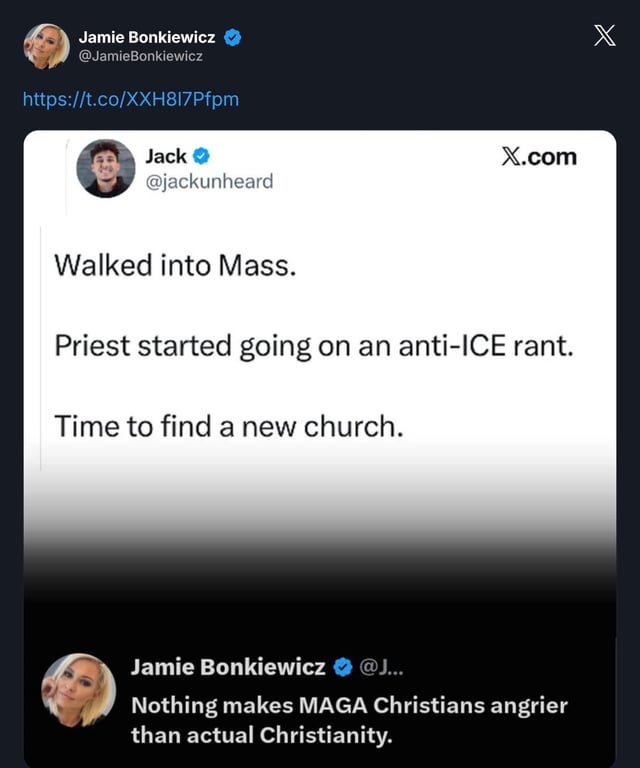
I do find it interesting how many arguments I’ll see online that rely on an idealized version of Christianity to make a point of Christianity, as though Christianity would be pure if people followed the “actual” morals. But like, this is what it is, they’re talking about a Christian church in the United States of America and the argument is that if MAGAts followed that Christianity, they’d be following “real” Christianity. Christianity was an engine of colonialism and all of the genocidal violence within it; institutions are what they do, not what they say they want to do.
I think a lot of people don’t realize that they’re making conservative, revisionist narratives when they want to privilege hypocrisy in their arguments rather than morality.
I mean, it’s just quoting what’s in the new testament.
The hilarious irony is that Jesus was quite clear: the Law of Moses is eternal… therefore all the progressive christians have it wrong.
The whole “no you don’t have to get your dick chopped” thing comes from Paul… who directly contradicts Jesus on the matter.
Not even Paul said fuck all about slavery being wrong or women being actual people, and he had some very strong opinions on LGBTQ matters. (And Jesus was much worse.)
Not to mention that the early Christians were nothing like what came several hundred years later.
I mean, sure, but what I’m cautioning against is prescribing any normative definition or configuration of Christianity, as it then implies an idealized version is real, and therefore that the problem is that people aren’t following the religion the “right” way, not that there is something systemic that influences how the religion functions in society.
There were baptists in central Europe that allowed women to serve as pastors as early as the early modern period, which is markedly different than what Baptism is like in the US today. During the Second Great Awakening of the early nineteenth century, there were Christian denominations that practiced polyamory and collective property ownership. These were developments that coincided with Christianity as an institution of settler-colonialism and EuroAmerican imperialism, and they were certainly not accepted by larger or more formal denominations at the time; still wouldn’t be today. It should also go without saying that they wouldn’t reflect the churches in the period you’re referring to even if just because they emerged in relation to what came afterward.
It is important to deny ownership of moral values by the institutions that configure and disseminate them for this exact same reason. Even though they serve a purpose within the system they exist in, they meet a need of the people who subscribe to them, and normativity is what stifles their ability to wrestle that utility away from these institutions.
Oh sure, I think my point was more that they’ve cherry-picked what “version” they want to idealize.
Yes, I’m saying “cherry-picking” suggests there are bad and good cherries, when it’s just cherries.
Well, it’s arguable that some of these religious “cherries” are worse than others, but I don’t find any of them to be crisp and delicious.
Yes, exactly, it is arguable, which why I’m saying that you can’t say there’s actually “good” or “bad” cherries.
Check out “postructuralism” and scholars like Derrida or Foucault. The role that language plays in our constructions and effects on things forces us to interrogate the reality of how we understand this thing to be “good” or “bad,” as it is itself subject to the systems of power we are subject to. So, it’s very hard not to reproduce the values we’re trying to challenge when we don’t address how those values are constructed.
Yes, we all know white supremacy is bad, but if it is only bad because it hurts people, then many people think that it only exists at the level of individual actions, like calling someone a slur, and not at a systemic level like how laws and knowledge are oriented around fundamentally devaluing certain groups of people; or why it is those groups of people in the first place besides “hating what’s different.” White supremacy does hurt people, and that is bad, but our understanding of how it does that changes how we understand what is needed to end it.
Is this not just lack of abstract thinking?
I think you think that I am failing to think. I also think you are mistaken.
I’ve read Foucault, and you’ve made a compelling argument. But I don’t get what you’re trying to say in this last comment.
So you think you have a better chance of fighting religion as a whole than to get people to follow an idealized version of Christianity, the one that they advertise as when they want to be seen as a force for good.
There is an idealized definition and configuration of Christianity, its Jesus Fucking Christ. Do you act like him and what he taught (or at least try your best to)? Christian. Do you do literally the opposite of what he did and taught? Not Christian. It not hard.
Hey everybody, I’ve got super powers!
Yeah, it’s also not an “airtight” set of beliefs. The bible is a messy collection of books distant from each other in time and goals. You can probably find a passage to justify any point.
Folks looking to use it for their own means are spoiled for choice. Have been for centuries.
But that’s also like, the point. The practice of scripture is about having a shared tool to make sense of things as it is the faith that that tool is indeed the right one to do so. Everyone uses it for their own ends.
Absolutely! It’s a pretty effective gimmick
I think a lot of you have a hard time understanding why religions do harm, and are a bit too prideful about knowing that they do often cause harm.
It isn’t a “gimmick,” and it is also deeply settler-colonial to suggest whatever form of knowledge production you subscribe to happens to be the “right,” one. Many cultures that didnt invent the bigotry we hate also practiced scripture, and devaluing that as a “gimmick” is not only racist, but irresponsible. If being “rational” was insulated from the context that “rationality” existed in, the white men would have fixed themselves in their salons when they thought they were too good for it all. Big surprise:
???
Any religion or philosophy can be twisted for the interests of any state or group. Whether it be Abrahamic religion, Buddhism, Hinduism or State Atheism. I would blame the State more than any Religion itself. It seems very Western-centric to blame Christianity as if it’s anything unique, because if any religion or philosophy had been dominant it would still be exploited by government. What you said that people say about Christianity are also said by people in various religions.
I am still not sure if religions themselves are to blame, or if it is their societies.
The livonian crusade brought
serfdomgod and good morals to my people, I’m sure they were happy!Nah seriously, we still had tribes with pretty loose organization some thousand years ago. Then 800 years ago some lovely people decided the pagans needed God and of course that meant God’s order: feudalism.
Christianity marked a shift in how humanity thought of itself. The earth, nature, and all the animals were made for men, by the one true God, to use and take as they pleased. This line of thinking led to colonialism, slavery, and even capitalism and the patriarchy.
Doesn’t the book of Genesis come from Judaism?
Well Judaism isn’t evangelical. It didn’t sweep though Europe and have the same kind of power.
Colonialism and capitalism absolutely.
I’d argue patriarchy and slavery already existed with other justifications though Christianity was used to entrench them further.
Well the transatlantic slave trade specifically and its extent. The argument, by otherering Africans, in their depictions of them, they then fell under the purview of Christianity’s dominion over everything. And the patriarchy, influenced by Christianity, helped solidify it in western culture.
I’m going to have to see a big ol’source for that one. You’re saying that’s a Christian thing exclusively, and not found in any of the cultural or religious influences on Christianity? How could you even begin to draw that line? Even more, you’re saying that, despite roughly fifteen hundred years of change, that was a core value that existed in the exact same way from the beginning of Christianity to European colonialism? Not even translations effected something so fundamental? Why would Christian patriarchy do this, but not Greek or Roman or Iranian? Why was it absent in Judaism but present here?
Even beyond that, you just subscribed to a normative construction of humanity and morality by asserting that capitalism emerged through this religion, and not that specific property relations and systems of power influenced how both are understood within our culture over time. For example, domination and objectification of the living world are certainly elements in this, but it’s difficult to argue Christianity is why that’s so and not that that was so, and Christianity exists as it does as a result of that.
Edit: I’m also just going to add that, though I’m sure this wasn’t intentional, this also ends up carrying deeply colonial and white supremacist notions of superiority by attributing that much gravity to the one religion that EuroAmerican imperialists happened to subscribe to. They got to have the religion that was so foundational, so world-changing that it marked a break in the entirety of human self-perception? I get were saying capitalism is bad, but exceptionalizing it in this way reproduces narratives that white supremacists find favourable.
https://sceneonradio.org/s5-e1-in-the-beginning/
This podcast is where I first heard the argument. Coming out of Duke University, it’s very well researched. You’d have to listen to seasons 5 and 6 to get the whole story. They cover nuances that my blanket statement doesn’t.
Too many words past saliency. You attribute more than the source problem is.
Is the correctly angled form of a pattern of thinking that starts within the individual, and it often looks like:
“Judge me by my intentions, not my actions”
It takes a certain requisite amount of empathy and critical thinking to flip ‘intention’ and ‘actions’ into their proper paths using the self awareness route.
The only meaningful shortcut is the existence of a well patterned role-model(s) in that individual’s life.
Both are in short supply nowadays, leading not to self awareness correction, but to expanding the conceit outwards. “If the Christians were like…If the Senators were like…if Capitalism was like…”.
A simple trap, and one of the most effective ones in holding us back as a collective.
I’m not sure if you meant to use “salient” here (as in you’re using the word incorrectly), but I definitely wasn’t trying make my writing that.
I’m also not sure about what else is said here either. Plenty of people behave immorally despite having role models; and I’d hardly say good people are in short supply despite how doomers insist the world is right now. I’d also caution against resorting to individualist explanations for this as well, and I was trying to discourage that by emphasizing the relationality between individuals and systems.
This is also by no means nothing even remotely new, but the specific form of normativity that people engage with this from did indeed emerge from modern European colonialism, and therefore Christianized notions of moral purity. But by, “nowadays” I reckon you’re not positioning this as a centuries-long development.
And then, “holding us back,” itself casts a normative construction of how things ought to be, which is exactly what I’ve cautioned against. I’d hardly imagine your understanding of a collective addresses decolonialism in a way that doesn’t subordinate groups or values that are “holding us back,” from some idealized, “proper” state that thing should be in by now.
No, I meant ‘saliency’. The sentence called for the noun form, not the adjective base.
I just clearly failed to explain what it was that I found salient and it’s not as self-evident in the light of your message as I hoped. Alas.
I appreciate the reiteration, but you’re still
perpendicularparallel (Edit: Geometry is hard) to the point I was trying to make.Which does not contradict yours, but seeks to expose the individualist core from which the sentiments you are focusing on one abstraction layer above stem from.
I was not focusing on individualist anything.
Oh. This is my dear friend, ‘semantics’ and its effects on perception, isn’t it? That’s what’s going on here.
I have neither time, nor will for this particularly loathsome recurring motif, as of the time of this writing.
It does not matter if my point did not carry across, ultimately. Your message is still fine and if more people followed it, they’d arrive closer to what I was trying and failed to communicate anyways, so by all means, carry on.
Wow, the ego on this guy. I was trying to be gracious with the first comment and really tried to read it with good intent, but I’m not going take this one seriously.
For this who come across this and are confused as to why this person is incorrect (both in their point and how they’re arguing it) feel free to ask, as there are common distortions found here.
Yes, ego. Absolutely no other possible interpretation. My deepest apologies for wasting your graciousness, I am so undeserving of it, and you illustrate your point oh so well here…
[For those who come across this and are confused about this exchange: Do take the other commenter’s original message to heart, and see the rest of his interactions for a demonstration of ‘intent’ vs ‘action’ for a glimpse of mine.]