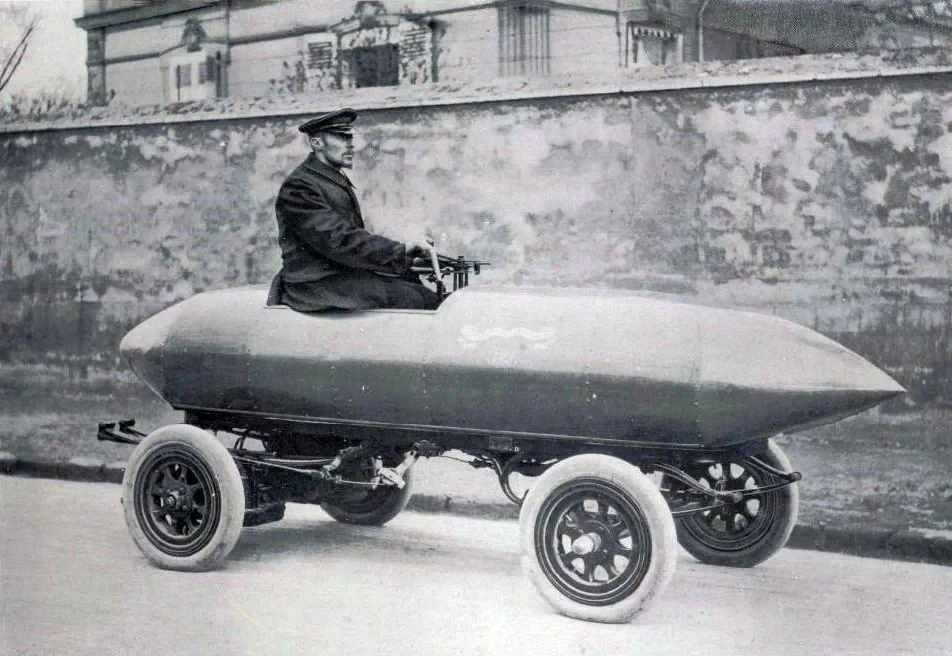

100km/h in those contraptions? Those were some truly courageous mad lads.

The vehicle had two Postel-Vinay 25 kW motors, each driving the rear axle via a chain, running at 200 V and drawing 124 A each, for about 68 hp total, and was equipped with Michelin tires.


The benchmark to beat was this at 92.69 km/h:

The 1899 Jeantaud Duc Profilée was powered by a 26.8 kW (35.9 hp) electric engine. The car weighed around 1,400 kg (3,100 lb) and transmitted its power to the rear wheels through a chain-drive gearbox. The Profilée was designed to be more aerodynamic than its older brother, featuring pointed ends on both the front and back, which allowed it to break the record top speed of 79 km/h (49 mph) of its less aerodynamic rival the GCA Dogcart on 4 March 1899, achieving a speed of 92 km/h (57 mph).
That’s awesome. Also shows how much oil companies have hindered the development of electric vehicles. Every other tech has 100x in 125 years, electric vehicles only became somewhat mainstream in the last 10-15?
Batteries have limited the development of electric vehicles. The only reason why battery research existed was consumer electronics. As for the motors, they really have not changed much in 125 years because they are already very efficient.
Only 2 of 5 of your media load for me 😢
Works for me
Reload or open in browser.
Reload does nothing
I wish one of the pages would list how that weight is distributed along the different parts. I would wager half of that weight, 700kg, was the battery, with the electric engine being ~250kg.
250 for the engine is way too much.
A typical 22kw electric engine today weighs about 200kg, so I don’t think 250kg is too much
https://www.auctelia.com/en/materiel-occasion/moteur-electrique-22-kw-weg-w22/uQ7C20m1XhI1_5uS6FaAM
That’s due to the materials, cooling, & interned (decades of continuous, low-vibration, & safe industrial?) use - the one you linked has a cast iron frame, which is prob the majority of those 200kg.
Here is a random example (bcs there is a table included with power & weight) under 100kg that looks about the same: globalsources.com/permanent-magnet-motor_1210699575f.htm.
But I def don’t know anything about electric motors 120 years ago, what was available, how the rich kids did their hobbies, etc.
And I do agree that the 250 estimate might not be too much -however that means that the car was unbalanced af & the driver had to sit on the opposite side of the (initially one) electric motor to provide counterbalance (instead of the motor just being mounted in the centre of the car)nvm, it had two.
Jamais Contente
Haha, perfect name.
I was thinking the same! how much that car must have fucked around he named it that
Yeah, but how was the range?
Pretty wild to make that streamliner body and then stick the driver out in the breeze like an afterthought.
If all we knew were horse drawn wagons and carriages this seating arrangement might seem more normal.
I thought the same thing at first too, but I think in that photo he’s sitting up on the edge of the “cockpit”. I’ll bet the actual driving position is further down inside the body with that wheel closer to shoulder level.
Edit: I would lose that bet! Found modern photo

Needs to feel the wind in his hair
Roll bars? Who needs ‘em!
Doesn’t matter. gonna be thrown out the vehicle immediately anyway.
It still gives me flashbacks to the PC game Mafia. There was a mission in that game where you drove a 1930s era open wheel racing car, without roll bars or anything. It was super easy to take a corner too fast and roll the thing. Your body snapped like a twig every time!