- cross-posted to:
- noncredibledefense@piefed.social
- cross-posted to:
- noncredibledefense@piefed.social
You must log in or # to comment.
Ayyyyy Oversimplified reference!
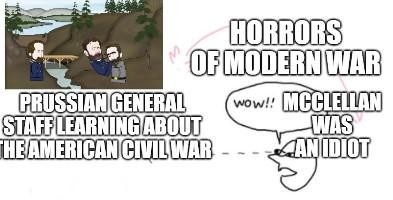
Explanation: During the US Civil War, Prussia (later Imperial Germany) sent observers along with both sides (as did several other countries) to observe this fascinating new war and potentially learn lessons from it!
To their credit, Prussia actually did take many of the lessons of the later war to heart - especially the lessons of industrialized warfare and supply as pursued by Union General Grant - and would apply them very successfully in the Franco-Prussian War. They also came away with the notion that the early Union General McClellan was an idiot who squandered opportunities to seize the initiative (true) and that Americans, as a whole, were terribly unprofessional about this war business (also true?)
I would love to see a study of if the construction of railroads in the USA contributed to a less capable Union Army.
If you mean more capable, I can actually recommend a book on the subject!
I mean a less capable general staff.
West Point was one of the few schools in the nation teaching some forms of military and civil engineering. Around that time, a lot of people who wanted to be civil engineers went to West Point, got out of their military service requirements as quickly as possible, and went to work on building the railroads.
Given that most of the railroad activity was in the North, it is possible that a lot of slots for West Point from Northern states were taken up by engineers who left the Army to go build railroads.
Ah, I see. That’s an interesting point!